Saturday, August 01, 2009

HTML is object code

Fate seems to be sending me a pretty clear message that my life's destiny lies in moderating discussions on the merits of CSS (240 comments and counting). Despite the fact that the argument seems to be going around in never-ending circles, and I've made several attempts to shut the discussion down, it just doesn't seem to want to die. When the market sends such clear signals, the thing to do is to ramp up production to meet demand. Hence, another essay on Tables vs. CSS. Pardon me a moment whilst I don my asbestos suit.

Whenever an argument among otherwise reasonable people turns intractable it is usually because both sides have overlooked something really fundamental, and I think this is the case here. The fundamental thing that both sides have overlooked in this case is that HTML is (or at least should be considered) object code. Let me explain what I mean by that.

Consider a hello-world program written in C:


main() { printf("Hello world"); }


Of course, this is not really a hello-world program. To get the "real" program you have to compile the above "source" code into "object" code, which looks more like this:


0000000 ce fa ed fe 07 00 00 00 03 00 00 00 02 00 00 00
0000010 0c 00 00 00 c0 03 00 00 85 00 00 00 01 00 00 00
0000020 38 00 00 00 5f 5f 50 41 47 45 5a 45 52 4f 00 00
[and so on for 12,588 bytes]


But now consider this:


0000000 6d 61 69 6e 28 29 20 7b 20 70 72 69 6e 74 66 28
0000010 22 48 65 6c 6c 6f 20 77 6f 72 6c 64 22 29 3b 20
0000020 7d 0a


Is that source code or object code? (Before you go on, take a moment to think seriously about what you think the answer is and, more importantly, why you think that's the answer.)

Here's a clue. Try this:


echo 'main() { printf("Hello world"); }' | hexdump


So if you said, "It's object code, because it looks like object code" you are wrong. But if you said "It's source code because it's just the hexadecimal representation of a C program" you are also wrong. The right answer is it's both. Yes, it's the hexadecimal representation of a C program. But just because it's C code doesn't necessarily mean it's source code. C is often used as an intermediate target language for compilers of other languages like Scheme. And Scheme can be used as an intermediate representation for other languages, like Qi. (Qi actually compiles to Common Lisp, but it's the same idea.)

Now consider this:


<html><div id="top">Hello world</div></html>


Is that source code or object code? In other words, is that code that a coder writes, or code that a compiler emits? Hopefully by now you realize that the answer is: it can be both.

I think a lot of the arguments against using tables for layout rely on the tacit assumption that HTML is source code. For example, one of the arguments against tables is that they fail to separate layout information from content. But this assumes that HTML is source code, and that the combination of content and layout information must be done in the browser. Neither of these assumptions is correct. I can create a layout as an html template:


<table>
<tr><td colspan=3> %header
<tr><td> %leftnav <td> %center <td> %rightnav
<tr> <td colspan=3> %footer
</table>


and combine this with separate content information on the server. Now my layout and content are completely separate, and yet I'm still using tables, and so I get the advantages of the simplicity and uniformity of cross-browser table rendering. Plus, my layout is only five lines of code. And it doesn't need Javascript. And it's going to look reasonable no matter what my content turns out to be.

IMHO, no one should ever write any HTML by hand. HTML should be considered exclusively as object code, except for the most simple of quick-and-dirty hacks. The idea that HTML can (or even should) be considered source code is the root of many evils on the Web. The right way to create web pages is by building higher-order abstractions in a programming language (preferably functional ones, but I'm not dogmatic about that).

Nowhere is this clearer than when it comes to forms. Even CSS advocates concede that it's OK to put form elements in tables. They say it's because "forms are a kind of tabular data, and that's what tables are for", but this just begs the question of how one can tell if a particular set of data is tabular or not. (Apparently, the criterion is: it's tabular data if it's completely hopeless to make it not look like crap when layed out with CSS.) But the trouble with forms goes far beyond layout. Consider the following:


<form method="GET" action="date-foo">
Enter the date:
<input type="text" class="dateinput" name="date">
<input type=submit>
</form>


Simplistic to be sure, but nothing offensive to the W3C standards. Now imagine a site that has this form and others like it throughout, and we want to augment our date input fields with a little javascript calendar widget. According to the philosophy of CSS we should be able to write:


.dateinput { ... }


but of course we can't, because the semantics of CSS are so hopelessly impoverished that the mere suggestion of doing something like this is probably enough to send CSS advocates into conniptions. (Any minute now, ChristianZ and Pherdnut will start to rant about how I Just Don't Get It (tm), and I need to study harder.)

But if we combine content and layout (and even style I might add) on the server, we can write:


<standard-form>
<date-input label="Enter the date">
</standard-form>


or something like that. Then we write a program that "compiles" this little private HTML-ish web page description language down to actual HTML for delivery to the client. Now changing all the date inputs to use a javascript widget is trivial, because we really have separated style from content, and we have done it in a way that is vastly more expressive and powerful than CSS.

There is only one argument for using CSS for layout that this approach does not completely demolish, and that is accessibility. CSS advocates argue that tables impede the rendering of web content for non-visual media. I think that's debatable, but even if it's true, it's irrelevant because there is no reason why the same content has to be rendered the same way on the server for all clients! This again assumes that HTML is source code, and you so you don't want to have different HTML for different clients because that would make extra work and violate the DRY (don't-repeat-yourself) principle. But HTML need not be source code. The source code can be a higher-level representation, and that higher-level representation can be rendered in different ways for different clients. For example, imagine a world where the client said to the server, "Give me web page FOO, and oh by the way, my user is blind" and what came back from the server was not HTML at all but an audio file. Now blind users wouldn't even need a special client! All they would have to do is configure a standard browser with a custom header to indicate blindness, and they're off to the races.

Separating styling and layout information from content is a great idea. But requiring that the rendering of those separate pieces be done on the client exclusively is overly restrictive because it requires that the kinds of combinations that can be done be standardized. It is that assumption that leads to the religious wars over CSS, not the merits or drawbacks of CSS per se. Whatever the standard is, it's either Turing-complete or it's not. If it's Turing-complete, you might as well just use Javascript (with all of its attendant problems) and if it's not, there will always be something that someone will want to do that's not possible. The answer is to cut the Gordian knot, treat HTML as object code, and do (at least part of) your rendering on the server. That way no one has to argue about anything. (Not that I expect that to stop anyone.)

Friday, July 31, 2009

Time Machine and Mail: a match made in hell

I've just spent the last two days debugging a problem I was having with Time Machine backups being freakishly slow (20 minutes to back up 20 MB). There's still some weird stuff going on, but along the way I discovered a problem that nearly everyone who uses a Mac will almost certainly encounter sooner or later, but I haven't found a single write-up on it. So here goes:

Time Machine is pretty smart about only backing up things that have changed since the last backup, and storing things on the backup drive in such a way that it *appears* that you have a ton of complete (not incremental) backups without actually duplicating files that haven't changed. It does this by using an OS X feature called FSEvents, which allows Time Machine to find changed files without having to scan the entire file system, and hard links, which allows Time Machine to store multiple backups efficiently.

This combination of features has some unintended consequences, most notably, if you use a mail system like Entourage that stores its messages in one big monolithic file. The contents of this file change every time you get a new mail message. So every time you get a new mail message, Time Machine has to back up *all* your mail, since it doesn't know how to look inside an Entourage mail file to find just the parts that have changed.

To avoid this situation, Apple has been recommending to developers that they store data in lots of little files instead of one big file, and they followed this recommendation in their own Mail application, which stores every message in a separate file. Unfortunately, it turns out this doesn't help matters at all, and in fact seems to make the situation worse.

The problem is this: imagine you have a folder with a lot of mail messages in it. A new message arrives, which gets stored in a new file. Time Machine knows that only this one file has changed, and so only this one file has to be copied. Unfortunately, to store this one file in a way that makes it appear that it's a complete backup, while it doesn't have to *copy* all those other files, it does have to create hard links for them all. And for small files, like most mail messages tend to be unless they have a lot of attachments, creating a hard link is no faster than actually copying the file.

So what happens over time is that your inbox grows and grows. Every time Time Machine runs you've almost certainly gotten at least one new mail message. So every time it has to create new hard links for every one of those zillion messages. So gradually Time Machine will get slower and sslloowweerr and sssssllllllloooooowwwweeeeerrrr, until one day you suddenly realize that it's pretty frickin' slow.

Fortunately, it's pretty easy to fix this problem: just create an archive folder, and periodically dump your old mail in there. As long as the archive folder doesn't change, it doesn't get copied at all. You should also do this with your sent mail folder, and your junk mail folder if you don't have it set up to automatically delete messages. If you're using SpamSieve, this can be a little tricky. This is actually what happened to me. I had set up SpamSieve according to the default instructions, which send spam to a folder that does not get automatically purged. Over time I picked up an obscene amount of spam, all of which was in one folder, none of which was being deleted, and which was constantly being added to. Time Machine was freaking out.

This is not a hard problem to avoid once you know what's going on, but it does seem to be one of the best kept secrets of OS X.

Dog days

I'm having an incredibly bad day. Actually, yesterday -- Thursday -- was the incredibly bad day. It's 4AM on Friday now. Can't sleep.

Meet Magnum:


Magnum is our next-door-neighbor's pit bull, and I swear he's the world's loudest dog. I tried measuring exactly how loud he was once using the Decibel app on my iPhone and it went off the scale. We've been listening to Magnum bark ever since we moved in to our house four years ago. We've tried everything. We tried being nice. We tried being nasty. We tried calling the police. Animal control. The humane society. We tried everything. Finally, after our neighbor cut off all communication (letters we sent started coming back "return to sender") we filed a lawsuit.

That seemed to do the trick. For a while the barking got better. The deadline for responding to the suit came and went and we thought our neighbor was just going to roll over, so to speak. We were looking forward to putting the whole situation behind us.

Then in the last few days the whole thing came unraveled. Our neighbor hired a lawyer, filed a response, and the dog has started barking again. We've been served with stacks of discovery forms to fill out. We've been told that she intends to fight us "tooth and nail." We're looking at potentially tens of thousands of dollars in legal bills and months of drawn out litigation. Last night, Magnum started barking again and after he had been at it for an hour I just lost it and had a pretty serious meltdown. And now I'm up at 4AM because I just can't get over how the situation has spun so wildly out of control.

All over a fucking barking dog.

I'm amazed at how blase people are about barking dogs. We have loud barking dogs all over our neighborhood. All except this one are too far away to bother us, but all those dogs have neighbors too. How do they deal with it?

Letting your dog bark really ought to be against the law. There's no difference between having your neighbor's dog barking at you and having your neighbor screaming at you through the fence. I doubt many people would put up with the latter; why do they put up with the former?

This is really driving me crazy.

Sunday, July 19, 2009

This is really scary

This is the scariest thing I've seen in a long time. I've always known that the right wingnuts have an extraordinary facility for detaching themselves from reality, but this guy really takes it to a whole new level. He's been producing these rants for a long time. George Bush came and went and smashed Ronald Reagan's all-time record for time off work while in the presidency (and Reagan wasn't presiding over a war that he initiated) and not a peep from Bob. But put a Democrat in the White House and he goes non-linear over a freakin' baseball game! There are a lot of things one can legitimately criticize Barack Obama for, but not working hard enough isn't one of them.

This extraordinary capacity for self-delusion combined with the obvious anger-management issues should have us all on edge. We've seen this before. It doesn't end well.

Monday, July 13, 2009

Some questions for creationists

Since turnabout is fair play, here are some questions for creationists:

1. If God created the universe, what created God? And if the answer is "nothing", why could not the universe have been created ab initio as well?

2. Let's suppose for the sake of argument that *something* created the universe, and that we can call that something "God". Is there any reason to believe that the God that created the universe has anything to do with the sacred writings of the world's religions?

3. Which came first, man or animals? Genesis 1 says animals were created first. but Genesis 2 says the animals were created after man in order to keep him company. (I note in passing that that plan didn't work out so well, so God finally wised up and created woman). Which is it?

4. Did God create mosquitos and plasmodium? Parasitic wasps? The Tsetse fly?

5. How did kangaroos get to Australia without leaving any trace on any other continent? How did the Texas blind salamander get to Texas?

6. Why did God make the Hawaiian Islands chain in just the right way to make it appear that the earth is billions of years old?

7. Where does the cosmic background radiation come from?

8. According to Genesis, the reason humans speak many languages is that they tried to build a tower to reach heaven and God "confused their language" in order to foil their plans. Is this story true? If so, why have our space probes not attracted God's ire, or even his attention? Has heaven moved?

9. Why are there fish that live in pitch darkness but still have eyes?

10. Why has there never been a dinosaur fossil found above the K-T boundary? And where did the Iridium come from?

11. Why did God put telomeric DNA in the center of chromosome 2 in humans?

12. Did Adam and Eve have to wipe their butts? No, seriously. The reason humans have to wipe their butts and other animals don't is that we walk upright, which presses our ass cheeks together. In evolutionary terms, walking upright goes hand-in-hand (so to speak) with having a brain big enough to figure out that you need to wipe the extra shit off, and hands nimble enough to actually do it. Was this all part of the Intelligent Design?

I think maybe I'll stop there :-)

OK, I'll bite

Walt Brown poses 37 questions for evolutionists. (UPDATE: I somehow ended up with 38, but I don't feel like going back and figuring out where I lost sync.) Although he's clearly trolling, I find I can't resist taking a crack at them. Unlike many scientists, I think it is important to occasionally answer creationist propaganda because you never know who might be lurking. So here goes:

1. Where did the space for the universe come from?
2. Where did matter come from?
3. Where did the laws of the universe come from (gravity, inertia, etc.)?

I'll answer these three as a group since the answer to all three is the same: we don't know. (By "we" I mean Scientists, with a capital S, which is to say those who believe that science is the most reliable guide to metaphysical truth.) We can run the laws of physics backwards to a tiny fraction of a second after "the beginning", but no one knows why there is something rather than nothing. Various theories have been proposed, the most popular being the anthropic principle. Personally, I'm perfectly happy just having it be a mystery.

4. How did matter get so perfectly organized?

If you think matter is "perfectly organized" you obviously have not seen my desk.

5. Where did the energy come from to do all the organizing?

Nearly all of the energy required to do the organizing that we find here on Earth comes from hydrogen fusion happening in the sun. A tiny amount has recently come from uranium and plutonium fission. The uranium was produced in supernovas.

6. When, where, why, and how did life come from non-living matter?

We don't know, but there are various theories of abiogenesis. A lot of progress is being made in this area, and it is quite conceivable (perhaps even likely) that there will be an artificial genesis within our lifetimes. There is quite a lot of evidence that there was more than one genesis on Earth. Paleontological evidence indicates that basic life arises very quickly (on geological time scales, so "quickly" here means a few million years) once the necessary conditions (which pretty much means just having liquid water and a supply of energy) have been established. Complex multicellular life took much longer to evolve than life itself.

7. When, where, why, and how did life learn to reproduce itself?

Life never "learned" to reproduce. Reproduction is the *definition* of life, and it's something that just happens more or less spontaneously once the necessary conditions (liquid water, energy, a few amino acids and enough time) are established.

8. With what did the first cell capable of sexual reproduction reproduce?

Like everything else in evolution, sexual reproduction evolved gradually. Even today we can observe primitive precursors of sexual reproduction in bacteria, which exchange small rings of DNA called plasmids, which are almost certainly the precursors of sexual reproduction.

9. Why would any plant or animal want to reproduce more of its kind since this would only make more mouths to feed and decrease the chances of survival? (Does the individual have a drive to survive, or the species? How do you explain this?)

The "drive" to reproduce is not a primary phenomenon. It is a side-effect of the very fact of reproduction, and the obvious, almost circular observation that things that have a "drive" to reproduce reproduce better than things that don't have such a drive. So if such a drive can be built into an organism by its genes, it is inevitable that such a drive will arise simply because those organisms that possess it will reproduce more effectively than those that don't, and so be more likely to pass that drive on to their descendants.

10. How can mutations (recombining of the genetic code) create any new, improved varieties? (Recombining English letters will never produce Chinese books.)

This is a classic creationist straw man. Evolution consists of two parts: mutation, which is random, and natural selection, which is not random. It is natural selection, combined with a lot of time, that produces the "improvements." (I put "improvements" in scare quotes because they aren't actually improvements in any absolute sense.)

11. Is it possible that similarities in design between different animals prove a common Creator instead of a common ancestor?

No. Similarities by themselves don't prove anything. It is the similarities combined with a theory of how those similarities arise that "prove" (again in scare quotes because science never proves anything in an absolute sense) that life arose through evolution rather than by design. The theory of evolution has been worked out in exquisite detail. We know more or less exactly why different species share common traits. And it has nothing to do with a designer.

12. Natural selection only works with the genetic information available and tends only to keep a species stable. How would you explain the increasing complexity in the genetic code that must have occurred if evolution were true?

It isn't true that natural selection "only" works with the genetic information available. Mutation combined with natural selection generates new information ab initio. Nature is constantly saying, in effect, "Let's try this. Oops, that didn't work. Let's try that. Oops, that didn't work either." And after a few million tries it suddenly stumbles onto something that *does* work, and so now there is new "information", that *this* combination of genes "works" in the sense that it reproduces better than its competitors.

14. When, where, why, and how did:

Single-celled plants become multi-celled? (Where are the two and three-celled intermediates?)
Single-celled animals evolve?
Fish change to amphibians?
Amphibians change to reptiles
Reptiles change to birds? (The lungs, bones, eyes, reproductive organs, heart, method of locomotion, body covering, etc., are all very different!)

I don't know the answers to these off the top of my head, but you can easily look them up yourself. (BTW, birds evolved from dinosaurs, not reptiles.)

14a. How did the intermediate forms live?

Well enough to leave offspring. I don't understand this question at all. If you want to see how intermediate forms live, look at mixed-breed dogs, or mules. They are, essentially, intermediate forms.

15 When, where, why, how, and from what did:

Whales evolve?
Sea horses evolve?
Bats evolve?
Eyes evolve?
Ears evolve?
Hair, skin, feathers, scales, nails, claws, etc., evolve?
Which evolved first (how, and how long; did it work without the others)?
The digestive system, the food to be digested, the appetite, the ability to find and eat the food, the digestive juices, or the body’s resistance to its own digestive juice (stomach, intestines, etc.)?
The drive to reproduce or the ability to reproduce?
The lungs, the mucus lining to protect them, the throat, or the perfect mixture of gases to be breathed into the lungs?
DNA or RNA to carry the DNA message to cell parts?
The termite or the flagella in its intestines that actually digest the cellulose?
The plants or the insects that live on and pollinate the plants?
The bones, ligaments, tendons, blood supply, or muscles to move the bones?
The nervous system, repair system, or hormone system?
The immune system or the need for it?

A full answer to this question would amount to a textbook on evolution. Happily, such books have been written, and all you need to do if you really want the answers is go read one. If you don't want to do that much legwork you can start with this accessible account of the evolution of the eye.

16.There are many thousands of examples of symbiosis that defy an evolutionary explanation. Why must we teach students that evolution is the only explanation for these relationships?

Because it's the best explanation we have. If you come up with a theory that explains the data better than evolution you will become instantly famous.

17. How would evolution explain mimicry? Did the plants and animals develop mimicry by chance, by their intelligent choice, or by design?

Mimicry, like everything else, evolves because it reproduces well -- but only when it reproduces well. This is why you do not see arbitrary mimicry in nature, but only mimicry that serves some reproductive purpose, like mimicking a poisonous species to prevent predators from eating you.

18. When, where, why, and how did man evolve feelings? Love, mercy, guilt, etc. would never evolve in the theory of evolution.

Of course they wold. All of these "feelings" (scientists would call them "instincts") serve easily demonstrable evolutionary purposes. Love, for example, helps bond humans into groups which are necessary for survival, because individual humans are quite vulnerable. Mercy helps prevent humans from killing each other. Guilt helps prevent actions that serve an individual at the expense of other individuals with whom that person may share genes. As with everything else in evolution, this has all been worked out in excruciating detail, mainly by a fellow named Robert Axelrod, who is probably the greatest scientist that no one has ever heard of.

19 *How did photosynthesis evolve?

I'm afraid I'm going to have to punt on that one. I just don't know. But I'm sure someone has worked it out. Try Googling for "evolution of photosynthesis".

20 *How did thought evolve?

Slowly. That's not a glib answer, that's the truth. Though resides in brains, which evolved over an extraordinarily long period of time though an extraordinarily complex series of stages, not all of which are yet fully understood. But we're working on it, and the pace of progress is breathtaking.

21. *How did flowering plants evolve, and from that?

See my answer to #19.

22. *What kind of evolutionist are you? Why are you not one of the other eight or ten kinds?

I didn't know there was more than one kind.

23. What would you have said fifty years ago if I told you I had a living coelacanth in my aquarium?

"Can I see it?"

24. *Is there one clear prediction of macroevolution that has proved true?

Yes.

25. *What is so scientific about the idea of hydrogen as becoming human?

What is scientific about it is that this idea has been worked out in great detail and it explains all of the available data (and that's a boatload of data).

26. *Do you honestly believe that everything came from nothing?

In the sense that you mean it, yes, I really do.

After you have answered the preceding questions, please look carefully at your answers and thoughtfully consider the following questions.

27. Are you sure your answers are reasonable, right, and scientifically provable, or do you just believe that it may have happened the way you have answered?

Yes, I believe that my answers are reasonable, right, and scientifically "provable" (to the extent that anything is scientifically "provable"). I've personally looked into this in great detail, and the scientific account of our existence hangs together a hell of a lot better than any religious one.

27a. (Do these answers reflect your religion or your science?)

Science *is* my religion :-)

28. Do your answers show more or less faith than the person who says, "God must have designed it"?

Less. A lot less. I can go to Hawaii and see the evidence that the earth is very, very old with my own eyes. And so can you.

29. Is it possible that an unseen Creator designed this universe?

Of course it's possible. But all the evidence indicates that's not what happened.

29a. If God is excluded at the beginning of the discussion by your definition of science, how could it be shown that He did create the universe if He did?

Video. It's the gold standard nowadays. And no, I'm not being glib. If God is almighty, producing video of the Creation should be well within His capabilities.

30. Is it wise and fair to present the theory of evolution to students as fact?

Yep. It's as well established a fact as it gets.

31. What is the end result of a belief in evolution (lifestyle, society, attitude about others, eternal destiny, etc.)?

I live in a nice house with a pool, two cars in the garage, a wife and a cat. Since I don't believe in an afterlife, I try very hard to make this life as good and productive and meaningful as I can.

32. Do people accept evolution because of the following factors?

It is all they have been taught.
They like the freedom from God (no moral absolutes, etc.).
They are bound to support the theory for fear of losing their job or status or grade point average.
They are too proud to admit they are wrong.
Evolution is the only philosophy that can be used to justify their political agenda.

I don't know, I haven't done a poll. I'm sure some people believe in evolution simply because it's what they were taught, and that's not good. Science education in general could stand to be improved, but not by introducing bogus, discredited theories that are clearly nothing more than thinly disguised Creationism.

33. Should we continue to use outdated, disproved, questionable, or inconclusive evidences to support the theory of evolution because we don’t have a suitable substitute (Piltdown man, recapitulation, archaeopteryx, Lucy, Java man, Neanderthal man, horse evolution, vestigial organs, etc.)?

We should certainly not use questionable evidence to support any scientific theory. Happily, the evidence for evolution is as rock-solid (literally) as it gets.

34. Should parents be allowed to require that evolution not be taught as fact in their school system unless equal time is given to other theories of origins (like divine creation)?

Not unless you think parents should be allowed to require that Newton's laws of gravity not be taught as fact unless equal time is given to alternatives.

35. What are you risking if you are wrong? As one of my debate opponents said, "Either there is a God or there is not. Both possibilities are frightening."

Read up on Pascal's Wager.

36. Why are many evolutionists afraid of the idea of creationism being presented in public schools? If we are not supposed to teach religion in schools, then why not get evolution out of the textbooks? It is just a religious worldview.

No, it isn't, it is solidly established scientific fact. And the reason we're afraid of the idea of creationism in public schools is because where it has been tried the results are pretty scary.

37. Aren’t you tired of faith in a system that cannot be true? Wouldn’t it be great to know the God who made you, and to accept His love and forgiveness?

It certainly would. Unfortunately, all the available scientific evidence indicates such a God does not exist. That is why believing in such a God requires faith.

38. Would you be interested, if I showed you from the Bible, how to have your sins forgiven and how to know for sure that you are going to Heaven? If so, call me.

Don't hold your breath.

Friday, July 03, 2009

A plea to the powers-that-be at Google

Would you please pretty please with sugar on top fix group search?

You get what you pay for

There have been a lot of stories about drywall from China used to rebuild the Gulf coast after hurricane Katrina producing a host of unpleasant problems including foul odors, corrosion in air conditioning systems, and a variety of health problems. As if that weren't enough, now it turns out the stuff might be radioactive.

Sarah Palin: Quitter

Sarah Palin has announced that she is going to resign as Governor of Alaska to pursue the presidency in 2012.

Palin was quoted as saying, "Some are going to question the timing of this."

Gee, ya think?


By leaving office early, Ms. Palin, a 45-year-old mother of five, will be able to travel around the country more freely and not be constrained by the duties and responsibilities of being a governor.


Excuse me? She doesn't want to be constrained by duties and responsibilities? And she wants to run for president? I wonder, will she resign the presidency mid-term because the duties and responsibilities of that office make her miss out on all the good shoe sales at Bloomingdales?

Good grief.

Wednesday, July 01, 2009

Say what?

From the twisted mind of Fox news comes this mind-bending pretzel of twisted logic:


Michael Scheuer : The only chance we have as a country right now is for Osama Bin Laden to deploy and detonate a major weapon in the United States because it's going to take a grass-roots bottom-up pressure because these politicians prize their office, prize the praise of the media and the Europeans ... it's an absurd situation again: only Osama can execute an attack which will force Americans will demand that their government protect them effectively, consistently, and with as much violence as necessary.

Glen Beck: If I were him that would be the last thing I would do right now.


So let me get this straight: According to them, we're in a situation where we're safe from everyone except Osama Bin Laden, and it's in Osama's strategic interests not to attack us.

And they see this as a problem? The only chance we have is for Osama to deploy a major weapon? Which he probably won't do? And this is somehow bad? Un fleepin' believable.

Friday, June 26, 2009

My Dinner with Erik

This post is about a man named Erik Naggum, who died in Oslo, Norway on June 20, 2009, apparently after a long bout with chronic illness. I say "apparently" because I didn't know Erik very well, and the official accounts of his death have been light on details (which is fine -- it's not really anyone else's business).

The reason I'm writing this is because despite the fact that I didn't know him very well, we had a very close, um, association over the years (it will become clear presently why I had to struggle a bit to find the right word to use). My name, for better or worse, has become inextricably linked with his in certain circles, and so I thought it would be appropriate for me to write something on the occasion of his passing. Death often provides an occasion for reflection.

I would like to start by setting the record straight about a couple of things. Erik and I were often very publicly at loggerheads and a lot of people believe that I had a personal dislike for the man. I didn't. I met him on only one occasion -- a story which I've never told, but which I will tell here shortly -- and we got along reasonably well, to the shock of many witnesses. To be sure we had deep and profound disagreements, but beyond those disagreements I knew (and to this day know) very little about him. I have no reason to believe that he was anything other than an honorable, hard-working man, but beyond that he was always a cipher to me. I mourn his passing because now that can never change.

My relationship with Erik is unique in that, with only a few exceptions, every interaction we ever had took place on a Usenet newsgroup called comp.lang.lisp. As a result, our relationship is chronicled in unusual detail, thanks to the eternal memory of the World Wide Web in general, and Google Groups in particular. Unfortunately, when I went to consult the record to prepare this piece I found to my dismay that Google Groups seems to be coming down with Alzheimer's. I would occasionally go there for a trip down memory lane, so I know it was working fine up until a few months ago. But last week, when I learned of Erik's death, I went to search for some of his old postings and found that Google's index of several Usenet groups has apparently been corrupted. The original raw data is all still there as far as I can tell, but the index that lets you search it has big gaping holes in it. As a result, I had to do the research for this piece manually, which is why it has taken me so long to finish this, and why I may well be leaving out some pertinent details. If you think I've missed something important, you're probably right.

To set the stage for people who may be reading this who aren't already familiar with the background, I have to tell you a little bit about comp.lang.lisp, or CLL as it is known amongst its adherents. CLL is a Usenet newsgroup, one of the earliest forms of on-line communities on what would eventually become the World Wide Web. Usenet itself goes back to 1979, and CLL to 1986.

My first post (as far as I can tell) was in February of 1990. Time Berners-Lee was still ten months away from writing the world's first web browser. The general public did not yet have access to the Internet, was not generally even aware of its existence, so everyone there was a computer geek. On-line communities (they weren't thought of as such back in those days) tended to organize around technical topics of mutual interest. CLL focused (and does to this day, at least ostensibly) on a programming language called Lisp, whose fans (and I was definitely one of them) tend to be unusually passionate about it. Lisp inspires love and devotion among programming language geeks the way that Apple's products do among gadget hounds. I won't get into why that is here because that would take me far afield. Just take my word for it.

Because of this common interest, and because Lisp tends to be somewhat of a black sheep among programming languages, CLL fostered a kind of camaraderie that went beyond its nominal scope, to the point that in March of 2003 when I felt the need to vent about the upcoming and IMO ill-advised invasion of Iraq, CLL is where I went. (Reasonable people can differ about whether or not this was appropriate. The point is, this is an illustration of how *I* felt about CLL. And I was apparently not alone because my post spawned a very long thread. But I digress.)

Erik Naggum joined CLL (again, as far as I can tell with search not working properly) in August 1994. (N.B. I'm actually pretty sure this is *not* Erik's first post because I have a vague recollection of looking for it several years ago when search was working properly and coming up with a different posting that was quite a bit earlier than this. But searching manually I couldn't find it.)

BTW, by drawing attention to the fact that Erik joined CLL several years after I did I in no way mean to imply that I had some kind of seniority privilege or anything like that. I am only pointing this out because I want to tell the whole story, and part of the story is that I've been observing Erik for a long, long time.

The thing that I remember first catching my attention was Erik's habit of not capitalizing the first words of his sentences. The second thing that I noticed about him was that he had a very no-nonsense take-no-prisoners style. And the third thing that I noticed was that he seemed very smart. But that was pretty much it. It was five years (again AFAICT) before Erik and I interacted in any way. My first participation in a thread involving Erik in any way was in February of 1999 and my first direct response to him was in March. If you take the time to follow those links you will see that there is nothing whatsoever remarkable about them, which is pretty remarkable in light of how things ultimately turned out.

Things didn't start to get tense between Erik and me until late August of 1999. This is not to say that things weren't tense. I was not the first to clash with Erik (but as fate would have it I would be the last). Erik was already getting into regular tussles like this one.

At this point I have to digress for a moment and say a word about my background. I am not doing this to be self-aggrandizing, but because the conflict between me and Erik ultimately hinged on differences of opinion, and I'm going to make some comments on those differences of opinion, and I want to provide a basis for you the reader to assess how much stock to put in my opinion. For example, one of the things that Erik wrote in the post I cite above was:


"what? a customer of a product has _invested_ in the company?! this is too fucking nuts to bother discussing."


The opinion I wish to express is that the position that Erik is dismissing is defensible. Not necessarily *correct*, but not so wrong that it can reasonably be dismissed as "too fucking nuts to bother discussing."

So let me tell you why I feel qualified to make such an assessment. One of the things I did in my career is to convince the powers-that-be at NASA to fly Lisp on a spacecraft, which was not an easy thing to do. The culture at NASA is extremely conservative when it comes to software technology, and Lisp was viewed with extreme suspicion. But I did it, and along the way I learned a lot about how managers think, and one of the things that managers think is that they *do* make an investment in a company when they buy that company's product, particularly a software product. Right or wrong, that's what they think.

I'm walking on eggshells a bit here because I don't want to start an argument with a man who is no long here here to hold up his end of it. I only want to point this out as an example of Erik's habit of taking very strong positions on matters that ultimately hinged on subjective issues, like what the word "investment" really means.

What bothered me about Erik's behavior was not that he was wrong. In fact, it was exactly the opposite. The problem was that he was usually right, and often people would try to argue with him when he was right, and often they would find themselves on the receiving end of some very harsh rhetoric. I saw two problems with this. First, it made it very hard to tell when Erik was right and when he was wrong, because taking issue with him could be so emotionally draining. And second, CLL was turning into not a very nice place to hang out.

It's important to keep in mind that I was not the only person who felt this way. A number of people had similar opinions. A few of them expressed their views openly if a bit inartfully.

And then there was this where Erik wrote (among other things):


"one of the things you will experience is that the community is very different from the Windows communities, whence it appears you come. for instance, the Common Lisp market is not marketing-driven, it is not a pyramid game that requires ever new people nor a bug-and-upgrade scam, and it is not leveraging its operational costs across a huge volume of sales. rather, it is a pretty mature market of long-term partnerships with a steady growth..."


Now, this really bothered me, not only because he was taking it upon himself to speak for the community (and I felt like I was part of the community and I never agreed to have him speak on my behalf) but also because I thought he was wrong. The Lisp market was *not* experiencing steady growth. I believed it was in fact in slow, steady decline (a belief which, sadly, has been at least partially vindicated by subsequent history). I also thought that Erik's very visible acerbic nature might be contributing to that decline even if only in a small way. And finally, I just found the man's arrogance to be incredibly annoying.

In August of 1999 I decided to try to do something about it. Having observed a lot of interactions between Erik and people who disagreed with him I knew that simply confronting him with my views would not work, so I chose a different tactic: I decided to try to engage him and model my behavior as closely as I could on his, expecting that this would lead to a confrontation. I would then reveal (privately of course) what I had done, and hopefully he would see that his style, having been on the receiving end of it, was counterproductive.

The exchange took place in this thread. My first engagement was in this message and it escalated from there, as I expected it would, at one point fulfilling Godwin's law.

I don't want to rehash the controversy over that exchange (there was a lot of it) but there are a couple of things that I think are important from a historical perspective. First, there were only four postings from me out of 183 total in the thread. I pushed only as hard as I thought I needed to to make the point. Nonetheless, by the end of our exchange, Erik was threatening to sue me, so I decided that things had gone far enough, and took the conversation to email.

I don't have those emails any more, and I wouldn't reveal their contents even if I did out of respect to Erik. (I did find this message from Erik in which he references that exchange just to show that I'm not making this up.) Suffice it to say, it turned out that I had misjudged the situation quite badly. My mental model of Erik had been very wrong, and my plan had, to put it mildly, not worked.

It was in this context that Erik and I had our first and only face-to-face meeting. It took place at the 1999 Lisp User Group Meeting (LUGM99) in San Francisco. This was the conference at which Erik delivered his now legendary "Long Painful History of Time" paper, as far as I can tell the only peer-reviewed work he ever published. To make a long story short, I managed to convince him to talk to me, and we had dinner together on the first evening of the conference. No one else was present.

When I was outlining this essay I had planned to write a paragraph at this point about my physical impression of Erik, which was nothing like what I had been expecting. But I've changed my mind for a couple of reasons. First, it's not relevant. Second, Erik was a very private person. He never published details of his personal life, nor as far as I know ever put a photograph of himself on the web. So I will respect his obvious desire for privacy and say simply that in person he was soft-spoken and very polite.

We reached an understanding at that dinner. I don't remember the details of what the understanding was -- this was ten years ago and it's not like we signed a peace treaty or anything like that. But by the time dinner was over, Erik understood -- or at least acted like he understood -- what I had done and why I had done it. The only evidence I have for this was that we got along for the rest of the conference, and this was witnessed by all the other attendees. I could have sworn someone wrote up an account of this on CLL because many people remarked on it at the time, but I can't find it. (Maybe it was in an email.)

(Ironically, at that same conference I also approached Kenny Tilton, with whom I had also been having some friction on CLL. He refused to speak to me, and to this day I have never had a real conversation with Kenny.)

I thought that would be the end of it. Things were quiet for a while. Erik and I didn't interact again until December, in a very unremarkable exchange, and then not again until February.

It all started to unravel in late February of 2000, when I posted this. Detente was not breached immediately. It was a slow, steady unwinding, and it's all there if you want to read it. I'll just note this where Erik wrote:


"I also vote that somebody write "the complete idiot's guide to special variables" instead of proposing silly language changes."


The result of that suggestion was this often-cited paper which owes its existence and its title to Erik.

It took a very long time for things to really deteriorate. Things were tense but still professional for a long time. As far as I can make out, the real turning point came in May, which ultimately led to this.

Shortly thereafter I quit JPL to go work for Google. I was absent from CLL for over a year, during which time Xah Lee stepped up to the plate. If ever there were two people who deserved each other, it was Erik and Xah. Watching those two go at each other was a truly tragic comedy.

I returned to JPL and CLL in August of 2001. My first post after my long hiatus was this one, which again is remarkable only for how unremarkable it is.

Things apparently hadn't changed much in my absence. I watched with some dismay asJohn Foderaro was driven from CLL. I thought this in particular was a little over the top. The understanding we had reached in 1999 seemed to be long forgotten.

I myself didn't enter the fray again until late August. This thread is notable because for about half a dozen messages I responded to Erik by cutting-and-pasting exact quotes from earlier messages of his. I was hoping this "replay attack" (a term of art from computer security) would remind him of our conversation at LUGM99. No such luck.

In retrospect I find it fascinating how the level of tension on CLL seemed to suddenly build in the days before the World Trade Center was attacked. Maybe there was something in the air. (For the record, I didn't participate in that thread.)

Erik and I never managed to rebuild the fragile truce we had forged in San Francisco. Our last exchange was this one after which, as far as I could tell, he not only dropped out of CLL but stopped posting in English altogether. (He posted a couple of things about me in Norwegian but I don't speak Norwegian so I have no idea what he said. Frankly, I think I'm just as happy not knowing.)

So that's my Erik Naggum story. I've told it as accurately as I can. There might be mistakes. I did the best I could under the circumstances. And I think Erik did too.

So farewell, Erik Naggum. Notwithstanding our differences, I actually learned a lot from you, and not least among those lessons is that life is short. So I will always remember our meeting in October of 1999 with great fondness. Everything else is lost in the noise.

First Iowa, now Ireland

Vying to replace Iowa in the the top spot on the list of last-places-in-the-world-I'd-expect-to-see-gay-rights-recognized Ireland has granted limited rights to same-sex couples.

In other news, temperatures in hell continue their plunge to unseasonal lows.

Best. Ad. Ever.

Who would have thought that potato chips could be so compelling?

Thursday, June 25, 2009

Microsoft does something cool. Frost sightings reported in hell.

I used to say that Microsoft never produced a technological innovation in its history, preferring instead to make money by stealing other people's ideas and squashing the competition with unfair business practices. But I have to admit that this looks pretty frickin' cool.

Wednesday, June 24, 2009

Barbarism in Iran

Not that they were ever great even before the "election" (there hasn't been real democracy in Iran since 1953 when the U.S. helped depose Mohammed Mosaddeq and install the Shah), but the situation in Iran is apparently getting really bad. Warning: there's a very graphic image on that link.

A summary for the squeamish:


An Iranian blogger (whose URL I will not publish) live blogging from Baharestan Square in central Tehran today captures but brief glimpses of the unimaginable horror that took place today. Bus loads of protesters were stopped and unloaded from their buses by "black-clad police" and literally herded. When the massing was sufficient, as the barely controllably distraught Tehran caller to CNN described first hand, hundreds of the regime's Basij thugs poured out of an adjoining mosque and commenced a massacre with axes, clubs, guns and gas.

Obama, Iran, torture, and hypocrisy

Someone asked me the other day if I was "pissed" at Obama. No, I'm not, at least not yet. But I am very disappointed.

Monday, June 22, 2009

The opposite of prohibition is not permission

Ron's First Law states, in a self-deprecating and hopefully somewhat humorous strange loop, that all extreme positions are wrong. But that is only a useful aphorism if you actually know what the extreme positions are. Unfortunately, many people mistake moderate positions for extreme one simply because the extreme positions are so extreme (and so obviously wrong) that they don't even enter the conversation.

Take gay marriage for example. This is framed as an argument between prohibiting gay marriage and allowing gay marriage, with the moderate compromise being civil unions or some such thing. But this misses a very important point: permission is already a moderate position. The opposite extreme of prohibition is not permission, it is requirement. The counterpart to prohibiting gay marriage is not allowing gay marriage, it is prohibiting straight marriage. Those are the two "extreme positions" that Ron's First Law warns against.

The same applies to abortion: the opposite of prohibiting abortion is not allowing abortions but requiring them.

There's another important point that people often miss: permission is not endorsement. Just because the law permits something does not meant that it's right or desirable, just that we've decided to place the responsibility of making the decision with the individual rather than the government. I personally think that it's a terrible thing to, say, raise a child as a creationist. But if there were ever a law proposed to forbid the teaching of creationism (in private -- public schools are different) I would be first in line to oppose it.

So you can be vehemently opposed to abortion and gay marriage and still oppose laws that prohibit them on the grounds of moderation, restraint, and (dare I say it?) even conservatism. Because once you set the precedent that it is acceptable to pass laws that support extreme positions, the only thing protecting you from the opposite extreme is your status as a member of the majority. And majorities are often fleeting, as the Mullah's in Iran are lately learning to their dismay.

More on placebos

They really do work.

Sunday, June 21, 2009

A response to quantamos

Quantamos took up my challenge and posted a response to my earlier post about gay marriage. It was long enough and well-written enough that it raised sufficiently legitimte points that it deserved a considered response, hence this separate posting.


fine. i'll comment. we'll see what you can do to assuage my queasy twaddle. good luck!


Thanks.


historically, fecundity was a matter of national security, since it was important to get lots of children to fill your battle lines, factories, voting booths, and to provide social security for the elderly.


It was actually even more important than that. Until not too long ago (a few tens of thousands of years) fecundity was vital not just to the survival of nations (because there weren't any) but to the survival of the entire species. That is why we have instincts hard-wired into our brains that drive humans -- even gay ones (I'll get to that in a moment) -- to reproduce. Our not-so-distant ancestors who lacked these drives didn't leave many offspring. Halting reproduction is not an idea that reproduces well.

But, to understate the case considerably, times change. The human species has in a very short span of time (a few thousand years) gone from being just another contender in the game of life to being its undisputed champion. The survival of our species is no longer under serious threat from any quarter except ourselves. To the contrary, we have been so successful that we are the predominant threat to the survival of nearly every other species on earth. And indeed, increasing our numbers beyond the carrying capacity of the planet is a very real possibility (some think we're already there).

So reproduction need not be attended to with the same urgency as it once was. Unfortunately, we are still left with the instincts, intuitions and social norms that evolved back in the day.

But even leaving that aside, your next assertion:

gay marriage takes two families out of the pool.

is simply not true. First, gay people can and do reproduce. Gay women can do so through artificial insemination, and gay men can do so through surrogacy, both of which are widely accepted means of heterosexual reproduction in cases of infertility. But this misses a much more important point: producing a baby is only the first (and arguably the easiest) step in a much longer and more difficult process. Human babies require years of care before they are able to survive on their own. That's the reason marriage is supposed to be a long-term commitment. It has nothing to do with making babies; it has everything to do with raising them. And gays are just as capable (in my experience often more so) of raising children as straight people. So the truth is the exact opposite of what you say: the shortage of resources is not babies; we've got babies aplenty. What there is a shortage of is couples who are ready, willing and able to raise those babies to adulthood. So it is not gay marriage that "takes families out of the pool", is is the prohibition on gay marriage that has this effect!

By the way, if you really believe that reproduction is such an urgent societal imperative that it should override people's right to marry whom they love, then it follows that having children ought to be required of all married couples. But this is obviously a political non-starter, which proves that virtually no one really takes this argument seriously.


i understand that japanese, europeans, and israelis worry about their demographics all the time, and in some sense, they're a forecast for our future. our country currently has the benefit of imported labor, but how much of the financial burden for our elderly will they be willing to bear? the pyramid scheme we call Social Security is already scheduled to blow up. in your previous post you said "Both are slowly but surely dying, and good riddance." (emphasis mine). surely you do not intend to propose that as a solution to the health care questions i'm raising. as a very wealthy man in a very wealthy country who has no concerns about your future, have you considered that you're committing "selection bias?"


Absolutely. But this is a separate issue. As I've already pointed out, when the topic at hand is gay marriage, reproduction is a red herring. I've actually been meaning to write about this. Maybe this will motivate me to finally do it. (It's a very complicated topic.)


here's what I'm queasy about. nobody's figured out a (sustainable) way to draw more money out of a pool than you put into it, no matter how big or complicated that pool is.


That's not true either. Economics is not a zero-sum game. If I have something that you want and I don't, and you have something that I want and you don't, and we make an exchange, then we have magically created value out of thin air. Likewise, technology can create more value than the sum of the parts that went into it.


this is why many gov'ts provide incentives to encourage the production of children of their own, because migrant workers are maybe not going to be willing to foot the bill. i'm not sure that it's fair to allow gay people to get those incentives, or to gain full access to social security if they've been unwilling to contribute as much as others through the hard work of raising children. it makes me suspect that gay marriage is fundamentally a selfish act. it's double jeopardy; they won't have children to bear some of the direct responsibilities so their care will cost more, and they won't have children paying into the system as a part of their indirect responsibilities.


Here again, if you really want to make this argument, you have to take into account the fact that many gay couples raise children and many straight couples (my wife and me included) don't. In any case, the remedy for this is not to make gay marriage illegal, but to change the rules about who is eligible for social security (and I think you'll find that's a political non-starter as well).


so will gay marriage raise my taxes to pay for elderly gays who draw more from the system than they put in?


No more than straight marriage raises your taxes for elderly straights who draw more from the system than they put in. Being gay has nothing to do with it.


the other historical purpose for marriage was to provide protection for women; financial, legal, and physical. our individualistic society has, it seems, obviated the need for this to some extent. but is it gone and will it stay away? i'm not sure, but i don't know enough to comment more on this.


I think that's wise ;-)


i'm worried that this whole issue is merely foolish populist rage at a time when scientists are prohibited from objectively studying and producing facts about the long term effects of this on society. so we do agree that there is "no demonstrable harm in allowing gays to marry" because the one thing activist groups accomplish for sure is to eliminate objectivity.


Now you're sounding like a conspiracy theorist. You acknowledge that there is no evidence that gay marriage harms society, but attribute this to unknown dark forces that prevent scientists from studying the matter and uncovering the diabolical truth. If there were a diabolical truth to be discovered there is nothing preventing the Mormon church from taking the hundreds of millions of dollars it puts into political campaigns and instead funding scientific studies to uncover it.


thank God we have bigots who stand in the way when crowd mentality takes over! i WANT the law to move at a glacial pace.


Are you familiar with Martin Luther King's famous letter from the Birmingham jail? I'll quote the relevant part for you:


We know through painful experience that freedom is never voluntarily given by the oppressor; it must be demanded by the oppressed. Frankly I have never yet engaged in a direct action movement that was "well timed," according to the timetable of those who have not suffered unduly from the disease of segregation. For years now I have heard the word "Wait!" It rings in the ear of every Negro with a piercing familiarity. This "wait" has almost always meant "never." We must come to see with the distinguished jurist of yesterday that "justice too long delayed is justice denied."


finally, i don't understand why people think it's so important for the gov't to play a regulatory role in their interpersonal relationships. what's the point in demanding the right to give up your rights? let gay couples sign contracts to accomplish the same thing! maybe you're not worried about what i just wrote, and you don't believe the gov't has a stake in the institution of marriage. if you believe that the historical motivations for marriage are obsolete, then shouldn't we pull the gov't out of it all together?


I'd personally be all for abolishing government recognition of marriage altogether and just having civil unions for everyone, but that's yet another political non-starter.


thanks for giving me the opportunity to solidify some of my thinking on this issue.


My pleasure. Thanks for having the courage to stand up for your beliefs.

Saturday, June 20, 2009

Google Usenet archive data lossage

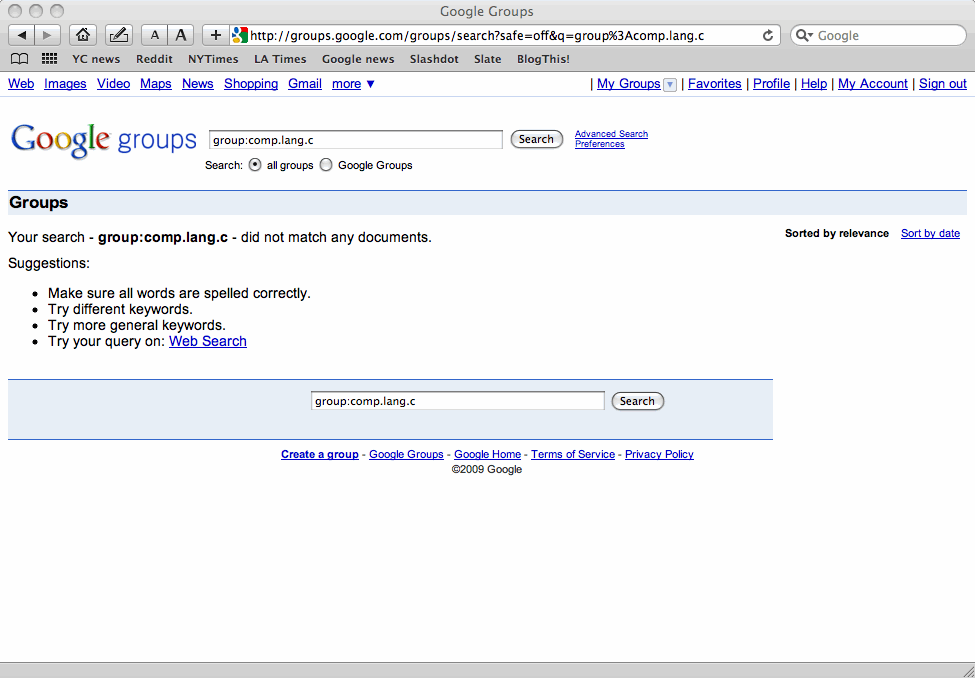
According to Google Groups today, there were only 227 articles posted to comp.lang.c between 1981 and 1995.

The effect seems to extend broadly across the comp.lang.* hierarchy. I haven't investigated beyond that. I hope this is a temporary glitch and not permanent data loss.

It's a little scary how much the world has come to rely on Google for historical data archiving.

Friday, June 19, 2009

Am I a bigot?

In my earlier post about the recent California Supreme Court ruling on Proposition 8 I wrote:


The overarching social trend in the United States is clear: the bigotry that drives people to deny gays the right to marry the people they love resides mostly in the older generation. Both are slowly but surely dying, and good riddance.


For this I was accused of bigotry. I freely confess to and apologize for a very poorly constructed sentence that left the impression that I was happy to see all old people die because some old people are bigots, or because statistically bigots tend to be old. I rejoice only at the prospect of the death of bigotry, not individual bigots. But that wasn't enough to satisfy my accuser, who responded:


You are tarring the "older generation" with the brush of bigotry. I hope you can see the irony.


So just to be clear: it was absolutely not my intent to "tar the 'older generation' with the brush of bigotry". It is simply a fact that prejudice against gays is more prevalent among older people than younger ones, and that the margin is substantial enough that it is a virtual certainty on simple actuarial grounds that shameful laws like Proposition 8 will eventually get repealed. That is all I intended to say.

There is, however, one form of bigotry to which I do subscribe: I am bigoted against bigots. I am intolerant of intolerance. I am prejudiced against prejudice. And in this I am an extremist. You may be entitled to your opinions, but you are not entitled to have those opinions respected merely because you hold them. Moreover, if you tacitly endorse bigotry through inaction or feigned injury (like, say, pretending that *you* are somehow hurt by the alleged damage done to the "institution" of marriage if gay people are allowed to marry each other, or by someone "insulting" your religion, or whatever) then you are in my book part of the problem. If you don't stand up for other people's rights then your forfeit your own. It makes mighty good rhetoric, but the sad fact of the matter is that we are not in fact endowed by our Creator with certain inalienable rights. We have rights because we as a society agree -- sometimes only at the end of painful and violent struggle -- to grant each other those rights for our net mutual benefit. Part of the cost of freedom is letting others be free.

If you want to be free to worship your god, if you want to be free to marry who you want, if you want to be free to speak your mind, but you are unwilling to grant those same freedoms to others, then yes, I am stubbornly and completely intolerant of you. If that makes me a bigot then I will proudly don the scarlet B.

Tuesday, June 16, 2009

Change? What change?

Barack Obama, taking another page from Dick Cheney's playbook, has blocked an MSNBC request to see the White House visitor logs. It seems transparency is just another piece of empty rhetoric.

UPDATE: Glen Greenwald has a much more comprehensive analysis of the Obama administration's record on transparency. It's not pretty.

Friday, June 12, 2009

Why health care reform matters

A friend of mine recently sent the following message to a mailing list I subscribe to:


We have a family friend who was diagnosed with 2nd stage breast cancer yesterday.

Several months ago she lost her job that provided health insurance. She continued her health insurance after losing her job, and set up automatic payment on a credit card. But then the card expired, and she didn't check the bills carefully and the insurance company dropped her.

Because she had a very expensive and difficult third pregnancy, no insurance company wanted her and the one that was legally required to provide the insurance was pretty happy to be rid of her. She spent a few months trying to get insurance, but then gave up.

Now she has cancer....

I'm curious - what happens to people like her.


The answer is, sadly: they go broke, at least in the U.S. Then they qualify for medicaid.

Or they die.

Or, in many cases, both.

My friend goes on to explore various options for this unfortunate woman, but the sad fact of the matter is that she's screwed, a victim of, depending on your political leanings, the private insurance system, or her own poor choices. Once you get a life-threatening illness while you are uninsured under our current system, that's it. Game over. You can never get insurance again, at least not for that illness. And it makes sense that you should not be able to, otherwise there would be an incentive for people to wait until they got sick to get insured. It would be like waiting to get auto insurance until after you had an accident. The entire system would collapse.

[UPDATE: it turns out that the situation isn't quite as bad as I thought. I learned, to my astonishment, that you can sometimes get coverage for pre-existing conditions after a waiting period of, typically, 12-18 months. But that's a long time to let a stage II breast cancer go untreated.]

So here we have the entire health care debate in a horrible nutshell. The conservative position is that people should be free to make their own choices, and must assume the responsibility that goes along with that freedom, and bear the consequences if they make bad choices or fail to pay their bills on time. The liberal position is that the consequences of getting those choices wrong are so severe both on an individual and a societal level that government intervention is necessary.

The U.S. is gearing up to have this debate (again!) right now. If you live here, you should pay attention, and urge everyone you know to pay attention too, because it really matters.

Thursday, June 04, 2009

Worst president ever: Bush... or Reagan?

Robert Parry makes a pretty convincing case that the Gipper ought to at least be a contender for the crown.

Monday, June 01, 2009

China breaks off diplomatic relations with North Korea (maybe)

According to Bloomberg News, China has suspended diplomatic relations with North Korea.

I don't normally post bare links to regular news items here, but this story is remarkable in that I can't find a single other news outlet that has picked it up (and neither, apparently, can Google). Normally in a situation like this I would just discount it as an Internet hoax, but Bloomberg is not exactly the Drudge Report. If it's actually true, this is a huge development in international politics. It completely changes the political landscape surrounding North Korea and their nuclear ambitions. I'm no journalist, but it seems to me that this is more important than, say, Susan Boyle taking second place on Britain's Got Talent.

So I'm not sure what is more interesting here, the story itself, or the fact that only Bloomberg seems to be reporting it.

Tuesday, May 26, 2009

Proposition 8 stands. And that's a good thing.

Minutes ago the California Supreme Court upheld Proposition 8, the voter-approved measure that bans gay marriage. Anyone who reads my blog regularly knows that I stand foursquare for allowing gays to marry, so this may come as something of a shock, but I think that in the long run this will prove to be a good thing for gay rights.

The overarching social trend in the United States is clear: the bigotry that drives people to deny gays the right to marry the people they love resides mostly in the older generation. Both are slowly but surely dying, and good riddance. It is therefore a matter of when, not if, Proposition 8 is ultimately reversed by the people and this shameful episode is relegated to the history books. But if the court had overturned Proposition 8 that would have energized the forces of bigotry and caused them to redouble their efforts. The fight would have been long and drawn out, probably over decades, just as it has been with abortion rights.

This way, it is those who support tolerance and freedom who are energized, as they should have been but weren't last year. Early polls showing Proposition 8 failing by 10 points caused supporters of gay rights to become complacent that the earlier California Supreme Court decision legalizing gay marriage would simply stand. But this was naive. Court decisions enforcing radical social changes rarely stand the test of time. At the end of the day (or the decade as the case may be) it is the people who decide.

So what will happen now is that there will be another proposition on the ballot in 2010 to overturn Proposition 8, and it will pass. It will pass by an overwhelmingly greater margin than did prop 8. It will pass because this time supporters of gay rights will not be complacent. It will pass because by November of 2010 the tide of history will be clearly turning against bigotry. While California denied its citizens equal rights, three other states have granted them and two others are poised to do so in the coming months. Furthermore, Californians will have been living for two years with 18,000 married gay couples in their midst and they will see that the sky has not fallen. It will be impossible in 2010 to paint gay marriage as the bogeyman because the bogeyman lives only in the abstract. But gay marriage is here, and the unraveling of the social fabric that was supposed to accompany it is not. In 2010 it will be impossible to condemn gay marriage without appearing manifestly delusional.

Proposition 8 will be overturned in 2010 because the forces of righteousness will be on the march as they were not in 2008 and the bigots will have nowhere left to turn. So hang in there, my gay brothers and sisters, justice is coming. And it is coming a lot sooner and with greater finality than it would have if the court decision had gone the other way.

Monday, April 20, 2009

It's the helium, stupid

Cold fusion is suddenly in the news again because of a recent 60 minutes story. For anyone who thinks that there is anything to this, I have only one word:

Helium.

Excess energy is a red herring. There might be excess energy coming from somewhere, but if you're fusing hydrogen, then you produce helium. No helium, no fusion. It's as simple as that. And I'm not talking about the trace amounts that have been reported, there should be gobs and gobs of it, certainly enough to float a toy balloon and remove all doubt. There's also the problem that all known hydrogen-based fusion reactions produce energetic neutrons. Really, cold fusion researchers should be dropping dead left and right from radiation poisoning, but failing that the radiation should at least be detectable on a geiger counter. So where are the videos of the cold fusion apparatus with a geiger counter buzzing away next to it?

If there's no fusion, there could still be excess energy, but it's almost certainly coming from some prosaic source, and it's almost certainly consuming palladium somehow. Palladium might be an economically viable catalyst, but it makes a mighty expensive fuel.

UPDATE: Here's the math.

The specific heat of deuterium fusion is about 1 MeV, which is about 10^-13 joules. To produce enough helium to fill a balloon (let's say a liter at standard temperature and pressure, or about 0.05 mole) we'd need to produce ~5x10^7 joules of excess heat. That's actually quite a lot, enough to raise the temperature of a cubic meter of water by 50 degrees C. Not enough to vaporize the lab, but definitely enough to get someone's attention.

But here's the thing: some of these experiments run for months at a time. Measuring small amounts of excess heat over long periods of time is very hard. But collecting and storing even small amounts of putative excess helium is very easy. Let's say that the excess heat is only one watt, it would only take a year to accumulate a liter of helium, and the fact helium was being produced would be inarguable after only a few days. So I still say if it were there someone would have exhibited it by now.

UPDATE 2:

I made a mistake in my calculations. There are actually two different deuterium fusion reactions. One produces 3He (helium 3, with two protons and one neutron) and an extra neutron, i.e. radiation. The other produces 4He, with two protons and two neutrons, and no extra neutrons. The second "clean" reaction also produces 23 times as much energy as the first one (or, equivalently, only about 4% as much helium per unit energy produced). It is also very rare. As far as I have been able to determine (which at this point means looking at a few Wikipedia articles) it does not occur in nature, and has not been achieved in more traditional "hot fusion" experiments. So I wrote off the possibility of achieving this reaction at room temperature as too good to be true. However, there are some plausible-looking reports of 4He production correlated with excess heat production in about the right amounts. So at this point I have to say that the possibility cannot be definitively ruled out. I still wouldn't bet my life savings on it, but if a policy maker were to ask me at this point I think I would recommend funding some of this research. These experiments are dirt-cheap by contemporary standards, and if it can be made to work it would be the single greatest technological breakthrough in the history of mankind. So it's worth putting some resources into it to determine definitively what, if anything, is going on.

The trouble with shadow photons

Chapter 7 of David Deutsch's "The Fabric of Reality" should be considered required reading for anyone who wants to understand the scientific process. Unfortunately, it is embedded in a book that is full of some crazy ideas, at least one of which is wrong even by Deutsch's own standards. This one mistake, which Deutsch makes very early on, infects the rest of his reasoning like a virus. This is very unfortunate because I think this is at least in part to blame for the fact that the book as a whole has not gotten the attention it deserves.

It makes a very interesting intellectual exercise to try to uncover Deutsch's mistake on your own. You don't need to be a physicist to find it. Here are two hints to get you started: the mistake is in chapter 2, and everything you need to know in order to figure it out is in this paper, which is written to be accessibly to a lay audience.

So at the risk of sounding like a broken record, get ye over to Amazon and buy a copy of Deutsch's book. Read chapter 7. Then read chapter 2 and try to solve this puzzle for yourself before you read any further. I promise you it will be time well spent. This post is not just about pointing a finger at David Deutsch and saying "ha! ha!" I want to make a much deeper point about how challenging it can be to figure out what is "true". It will help if you have the visceral experience of reading Deutsch's argument and trying to figure out for yourself what is wrong with it even if (perhaps especially if) you don't succeed.

Last warning. Spoiler alert.

Deutsch's mistake is in this paragraph, which in my copy is on page 43:

"Could it be that the photon splits into fragments which, after passing through the slits, change course and recombine? We can rule out that possibility too. If, again, we fire one photon through the apparatus, but use four detectors, one at each slit, then at most one of them ever registers anything. Since in such an experiment we never observe two of the detectors going off at once, we can tell that the entities that they detect are not splitting up."

In my "Quantum Mysteries Disentangled" paper I use the metaphor of a magic trick to describe how popular accounts of QM spread confusion. Most people think that magic is all about gimmicks and skillful sleight-of-hand, but the heart of a good magic trick is a narrative that seems plausible but in fact does not reflect the underlying reality. The elements of this narrative can be quite subtle. I take the Queen of Spades and I turn it face down and I put it, uh, over here. But in fact the card that I'm putting over here is not the queen of spades at all; I've already switched it out for a different card. Much later when the true identity of the card is revealed, you will swear on a stack of Bibles that that card was the queen of spades. You saw it with your own eyes. And you were watching it like a hawk the whole time. Except that by the time you started watching like a hawk the trick was already done. It happened during that little moment of confusion, when I lost my focus and couldn't quite remember what I was supposed to do next. In fact, I didn't lose my focus. Every move was scripted in minute detail. I say "uh" to make it look like I've lost my train of thought. That makes you take your guard down because if I've lost my train of thought then I'm not doing the trick. I look around trying to decide what I'm supposed to do with the card, and your gaze follows mine because deep down in your brain there are instincts that say when a member of your tribe is focusing their attention somewhere you should check it out too because they might be looking at a saber-tooth tiger. In that instant, I absent-mindedly put the card briefly back on the top of the deck before I put it over here. And in that instant I make the switch. Except that I don't even have to make a switch because in fact that card that I put on top of the deck was not the queen of spades either, it was two cards, with the queen of spades on the bottom.

Deutsch's mistake is a sin of omission: he fails to mention the crucial fact that when you do this experiment with the four detectors the interference goes away. This is a devastating fact for Deutsch's theory of shadow photons, but before I explain why there is another important thing to take note of, namely, that at this point in the argument Deutsch has not yet introduced the theory of shadow photons. This is what makes it so easy to miss that Deutsch has omitted an important fact.

The fact that adding detectors destroys interference is fatal for the theory of shadow photons. To understand why, we need to recap exactly what it is that the theory of shadow photons says: something influences the behavior of "real" (what Deutsch calls "tangible") photons to produce interference. Whatever that "something" is behaves just like "real" photons, except that it is "detectable only indirectly through ... interference effects ...". So we might as well call them (shadow) photons. Since shadow photons exist (because they have observable effects), it must be the case that entire shadow universes exist spanning an incomprehensible gamut of possible configurations, including some (actually incomprehensibly many) where David Deutsch does not exist, and therefore -- and this is crucial -- some in which the detectors on the slits do not exist.

This is the odd thing about shadow photons: they behave just like photons that exist in parallel universes except that their movements correspond exactly to the movements of photons in this universe. There are only two possibilities. One is that our universe is somehow privileged, and what we do here produces miraculous effects in the myriad shadow universes. If we decide to cover our slits then the photons in all the shadow universes are blocked, even those in shadow universes where the slits are still open. Imagine how puzzled those poor scientists must be trying to figure out why light behaves as it does. There is no correspondence between how light behaves in their universe and the physical configuration of their universe. Sometimes light passes through blocked slits, and sometimes it fails to pass through open slits. From this behavior they could likewise infer the presence of what is to them a shadow universe (which to us is the real universe) that governs the behavior of photons in their universe, but that just begs the question of why we happen to inhabit the one privileged universe whose macroscopic configuration governs the behavior of light in all of the shadow universes.

The other possibility is to postulate a new rule for shadow photons: only those shadow photons that come from shadow universes whose macroscopic configuration is the same as the "real" universe are allowed to influence "real" photons. But if we postulate that then it immediately follows that shadow universes with different macroscopic configurations have no influence on our universe whatsoever and therefore, by Deutsch's own criteria, do not exist.

One way or another, there is no escaping the fact that our universe is somehow special.

Now, the interesting this about this to me is not so much that Deutsch was wrong per se, but the process by which he came to be wrong. Unlike a magician, I'm pretty sure Deutsch did not set out intentionally to deceive. I'm also pretty sure that Deutsch didn't get it wrong because he was simply being stupid. To the contrary, I think Deutsch is probably brilliant, a lot smarter than me. For one thing, he's actually a physicist, which I'm pretty sure even now still makes an effective filter for idiocy. So what went wrong?

I have no way of knowing for sure, of course, but here's my best guess: I think Deutsch actually managed to fool himself. Deutch's book is, notwithstanding that much of it is actually wrong, a model of clear thinking. To find the flaw in his reasoning is not easy, in no small measure because of subtle details of how he presents his argument. This is why I urged you to actually do the exercise yourself.

The real point of this essay is not to harsh on David Deutsch, but to show that even very smart people, even scientists (sometimes especially scientists) can and do get things wrong, and sorting out the resulting mess is not always easy. This is one of many reasons why both scientists and Scientists ought always to maintain a healthy measure of humility.

UPDATE:

Here's what David Deutsch had to say about this (via email -- I'm pretty sure he hasn't actually read this post):


RG: I know you probably hear this a lot, but I believe I have found a serious flaw in the theory of shadow photons. In a nutshell, the rules of motion for shadow photons are governed by the macroscopic configuration of *our* universe. If a slit is open in *our* universe, both tangible and shadow photons pass through. If a slit is blocked in *our* universe, both tangible and shadow photons are blocked. It seems to me there are only two possibilities: either the macroscopic configuration of *our* universe governs the movement of shadow photons (in which case shadow-scientists must be mightily puzzled why their tangible photons sometimes pass through solid objects, and sometimes fail to pass through open slits), or we have to postulate that only shadow photons from universes whose macroscopic configuration matches our own can interact with our tangible photons.

DD: The latter is, to a good approximation, the case.

RG: But if we postulate this, then shadow photons from universes whose macroscopic configurations do not match ours cannot interact with our universe in any way, and therefore by your own criteria do not exist. Or have I missed something?

DD: You're claiming there's an inadequacy in the criterion for existing that I presented, not a flaw in the 'theory of shadow photons' (which is aka quantum theory). However, that criterion was not intended as a criterion of what *doesn't* exist. If it were used in that way, then we would have to classify all the photons that have left the sun, and passed the Earth, and are never going to strike anything in the future, as being nonexistent.


My response:

1. I find it disingenuous to claim that the theory of shadow photons is "a.k.a. quantum theory." The theory of shadow photons is in fact a.k.a. Hugh Everett's relative state formulation of quantum mechanics, which was later renamed the many-worlds interpretation by Bryce DeWitt. To be sure it is taken seriously by a great many people, but to say without qualification that it is quantum theory is just flat-out wrong. I appreciate Deutsch's intellectual honesty in essentially admitting that my criticism is valid, but I'm puzzled by how he can rail against arbitrary complexity in scientific explanations on the one hand, and then accept as essentially inarguable the proposition that parallel universes are causally connected on a microscopic level by virtue of their macroscopic configurations. It seems plain to me that such an "explanation" of QM gets you exactly nowhere. But I suppose we'll just have to agree to disagree about that.

2. John Cramer's transactional interpretation of quantum mechanics actually does consider photons that never interact with anything to be non-existent, so this is not as outlandish a notion as Deutsch implies.

UPDATE 2:

Deutsch just referred me to this paper which is the more formal formulation of his multiple-worlds theory. I must confess that on a cursory read it seems to be a compelling argument. So I may have to rethink this whole thing.

Just for the record, my (current) disagreement with Deutsch is not huge. It's clear from the structure of QM that the proposition that there is only one (classical) universe is untenable. But that still leaves you with the choice of an infinite number of universes (Deutsch's position) or zero (mine). It has always seemed to me that zero was the more parsimonious choice, but I'm now beginning to have some doubts.