Wednesday, February 27, 2013

A simple solution to credit card fraud, part 3


This is part 3 of a long story.

One of the reasons this story is so hard to tell is that it's hard to know where to begin.  The situation I find myself in today can be traced back at least to 2006, and possibly earlier than that, but does anyone really have the patience to sit through a book-length memoir?  I wouldn't.

So I'll skip 2006 for now (though that makes a good story too, and timely too because that's when I worked with Jody Sherman) and start on March 20, 2008, when I sent out the following fateful email to a mailing list of ex-googlers interested in angel investing and other startuppy things:
I just got back from the Y Combinator Demo Day and there are more promising-looking early-stage startups there than you can shake a stick at.  We don't have enough money to invest in all the ones that looked good to us, which got me to thinking: someone ought to put together a fund or a syndicate so that you could diversify across a fairly large selection of YC startups so that you could diversify without having to invest a huge amount of money.  Is there any interest in this?
There was.  I was soon joined by a dozen other Xooglers, including Brian Singerman who became my co-founder in a small fund that we called XGYC (Ex Googlers investing in Y Combinator companies).  I volunteered to do the administrative work because I was very green and I thought I would learn a lot.  I did learn a lot, including the fact that administrative work sucks.  It's boring and it's repetitive, but it's necessary and you have to pay attention because if you miss a deadline or get something wrong then you have to go back and fix it and it's an even bigger pain in the ass.

By far the biggest PITA was (and remains to this day) actually managing the money.  The mechanisms that we in the U.S. have for moving money around are horribly antiquated, inefficient, and insecure.  I actually started learning this before XGYC, when a six-digit wire transfer was lost for two weeks because the sender had filled out the (paper) transfer form incorrectly.  And when I say lost I mean lost.  No one knew where the money was.  There was no way to track it.  The only reason it was found was because the person who received the money (some random stockbroker) contacted the sending bank and gave it back.  Yes, I know this is hard to believe.  I didn't believe it myself at the time.  Some day, if there's enough interest I'll write up the details.  (I keep telling you this is a long, complicated story!)

Anyway, for a high-tech entrepreneur there are no problems, only business opportunities, right?  I gazed into my crystal ball and saw a day when YC demo days would be much bigger, there would be a lot more angels out there dealing with the exact same problems I was facing, filling out the same forms over and over, dealing with the same accounting and legal BS over and over, and decided that there could be a market for a sort of "angel syndicate in a box" type product.  The idea was to integrate tools to simplify or automate all the standard repetitive tasks that I was doing by hand.  In particular, I wanted to streamline the accounting.  Standard SOHO accounting packages are not designed with investors (or even high-tech startups) in mind.  They're all about managing inventory, accounts receivable, yadda yadda yadda, and their UIs are a disaster.  Five years on and I still can't figure out how to make Quickbooks behave.

The key, it seemed to me, was to integrate the accounting with the money transfer somehow.  One of the biggest problems I was facing managing XGYC was keeping track of who had paid what when, particularly when wire transfers were involved.  An incoming wire would show up on the bank statement without any description of what it was for, only an indication of the bank that sent it.  Sometimes I could figure out what it was based on the amount, but often, particularly at the beginning when the syndicate members were making their capital contributions, there was no way to tell whose money had come in, and I had to send out emails asking people to send me the reference numbers for their transfers.  Later, after we started making money (The fund has done quite well, thank you very much!) I would send out distribution checks and people would fail to cash them.  Don't even get me started about the problems that causes!  (I will probably be writing a future entry about checks and the myriad problems they cause.)

The more I learned about how the financial world works under the hood the more shocked and appalled I became.  The whole system seemed (and still seems) to me like it was being held together with spit and bailing wire.  To this day I am amazed that it works at all, let alone that it works as well as it does, and it does work quite well considering how deeply broken it is.

Still, it was 2008, and there was (and still is) a lot of room for improvement.

I came up with a fairly detailed plan for an integrated banking and accounting service specifically targeted at startup companies and their investors.  I still think this would make not just a viable product, but a kick-ass company that could be the Next Big Thing.  But I gave up on it last March after working on it for three years.  The TL;DR version of why I gave up is that I was never able to find a satisfactory way of moving the money around.

Moving money turns out to be a very complex and subtle process.  It's conceptually very simple, and if you use cash it is very simple: I give you a dollar.  Now you have a dollar more, and I have a dollar less.  Alas, that is where the simplicity ends, because sooner or later that dollar ends up being deposited into a bank.  And that is where all the trouble starts.

(Some people think the trouble starts when you consider a piece of paper to be money in the first place instead of, say, gold, but they are wrong.  This is another tangent that I may write about some day, but for now suffice it to say that very few people actually seem to understand what money is or how it works, including many people who work in the banking industry.  But I'm getting way ahead of myself.)

Don't get me wrong, I think banking is a terrific idea.  The problem with today's banks is not that banking is inherently bad.  Modern technological civilization could not have been built without banks.  The problem with today's banks is that they have forgotten the business which they are supposed to be engaged in, which is to allocate capital and manage risk.  Notice that I said manage risk, not avoid risk.  To the contrary, when the banking system is working properly the banks willingly take on (managed) risk.  But today's banks avoid risk by any means necessary, including fobbing it off on third parties or the government.  This is great for the bank's bottom line, at least for a while, but it's an unmitigated disaster for society.  But again, I'm getting ahead of myself.

My plan was this: for every person or entity participating in my system, I would open an account for them at some bank who would become my partner in this business.  All of the initial capital would flow into this bank by traditional means.  But once the money was in the system, all "in-network" transactions could be conducted by initiating inter-account transfers within that one bank.  Moving money between two accounts at the same bank is a lot easier, safer, faster, and cheaper than moving money between banks.  Furthermore, it's a lot easier to undo mistakes.

The beauty of this business model is that it has a natural viral component: not only could investment syndicates use it, but the companies they invested in could us it too.  And their employees.  And their vendors.  And there could be a whole slew of ancillary services as well.  It could be Y Combinator, but on-line and with a nationwide or even global reach.  I called it Founders Forge.  And, of course, every participant would get a secret key with which to authenticate themselves to the system and authorize transactions. Eventually, as the user base grew we would gradually become the basis of a new, more efficient and more secure financial system that would eventually and stealthily squeeze out the older, less efficient system.

Now, those of you who like to shoot holes in people's ideas, before you take pot shots at this idea please keep in mind a couple of things.  First, what you have just read is a very abbreviated version of the actual plan.  In the interests of not turning this story into War And Peace I have left out a lot of detail.  Second, I am not an idiot.  I am well aware that banks operate under a very strict regulatory regime, that they are highly risk-averse, that they avoid innovation like vampires avoid the sun.  My plan took all this into account.  I had (still have) a detailed risk-mitigation strategy.  If you really want to know, I would be more than happy to go into excruciating detail.

None of that matters to the point I want to make with this story, as you will soon see.

I took this plan to my local Wells Fargo, which was the bank where XGYC has its account.  I figured it would be an easy sell.  I would be bringing them tons of new high-quality customers.  And it was an easy sell.  The idea got a very favorable reception from the branch manager, and the pitch started working its way up the chain of command.  I stopped worrying about the bank, and started writing code.

But a few weeks later something very peculiar and unexpected happened.  By that point I had been handed off to a regional management team, and I hadn't heard from them in a while, so I sent an email asking what was going on.  They replied that Wells had changed its mind and would not do business with me.

When I asked why, they said they couldn't tell me.  All they knew was that they had received marching orders to kill the deal.

Weird.  But OK, if at first you don't succeed...

Fast forward a year and a half, and half a dozen or so banks.  Same story, again and again and again: initial enthusiasm, followed by a sudden change of heart with no explanation.  The only exception was a small regional bank where I was able to pitch directly to the CEO.  He said he loved the idea, but was couldn't do it because their charter prevented the from having non-local customers.  That was the only time I got a straight answer out of a banker.

It gets worse.

By this point I was very discouraged, but far from ready to give up.  Still, I wasn't quite sure what to do because I didn't have a good model of what was going wrong.  I had no idea what to change to increase my chances of success.  I talked to everyone I knew who had even the remotest connection with the financial world and the reaction was always the same: This is really weird.  Your pitch sounds great.  I have no idea why a bank would not want to work with you.

I kept at it.  I tried everything.  I tried credit unions.  I tried Silicon Valley Bank (which turns out to be astonishingly backwards in its approach to technology even by banking standards).  You name it, I tried it.

Finally, I caught two breaks.  The first was a bank called Square1 (no relation to Square, which wasn't founded until a few years later) which was receptive to the idea.  For the nth time I worked my way up the food chain and got to the CEO, but before I could meet with him he had a heart attack and died.  No, I am not making this up.

My second break was First Republic Bank.  I got as far as face-to-face meetings with their CTO and other senior staff.  Then one day, many months in to the process, they all stopped returning my emails.  I found out later that everyone I was dealing with had left the bank.  As far as I know, all the departures were independent and had nothing to do with me.  I tried to resurrect the deal, and got as far as a face-to-face with the new CTO.  He told me he was interested, but was ultimately unable to convince senior management.

By now I was very discouraged, but still not ready to give up.  I tried one last strategy.  Maybe the problem was me.  Maybe I was too geeky.  Maybe I didn't know the secret handshake.  So I enlisted the aid of a friend of mine, a Harvard grad, a complete non-geek, strong business credentials, blue blood, comfortable in a suit and tie.  He had been interested in being a co-founder, so I delegated the job of closing a bank deal to him, and I gave him a strong lead.  We were both extremely careful, working our way step-by-step up the chain of command, getting everyone on board, until we got to the CEO.  We pitched him, and he said yes, but with one condition: he wanted us to be venture funded.

Up to that point I was self-funded, mainly because I didn't need the money, but also because the business case was immensely stronger with a bank on board.  The whole model lived and died on the ability to quickly, cheaply, and reliably move money around, and to do that we needed a bank.  (Yes, I know about ACH.  I'll write a whole nuther post on why that wouldn't work.)  But OK, if the difference between getting my key vendor and not was raising a round, I would raise a round.  I had good VC connections, and within a week I had lined up three of them.  I called the bank back and told them about my progress, and that these VCs would like to talk to them as part of their due dilligence.  That was when this bank, too, pulled out.  No credible explanation.

That was March of 2012.  That was when I decided to fold up the tent.

But, of course, that is not the end of the story.

[UPDATE:] Responding to some comments over on Hacker News, I am not drawing this story out because I'm trying to be cagey.  I don't know why all the banks did what they did.  It's a mystery to me.  That's one of the reasons it's hard to write about.

No, it's because he was behaving like a childish jerk

Liberal news outlets are gleefully reporting an incident on Fox news this morning:
Rep. Keith Ellison, D-Minn., was kicked off of Sean Hannity’s Fox News show during a segment that started out about the sequester, but which devolved into six minutes of the two yelling at each other [emphasis added]. Ellison called Hannity everything from "the worst excuse for a journalist I’ve ever seen" to "a shill for the Republican Party."
Except that if you watch the segment you will see that it was not six minutes of the two of them yelling at each other, it was six minutes of Eillison yelling at Hannity and generally behaving like a sixth-grader, with Hannity politely trying to get a word in edgewise.  I was cringing the entire time I watched it.  I am no fan of Fox news, so it's unfortunate that Ellison's childish conduct completely overshadowed the fact that what he was saying was actually true.  Hannity is a shill for the Republican party, and he is a pathetic excuse for a journalist.  But Ellison, at least for these six minutes, was a pathetic excuse for a leader, and that is the only thing that any non-Democrat is going to remember from this interview.

Tuesday, February 26, 2013

In the interests of full disclosure...

I'm back, and I'll be posting the next installment in my series tomorrow, probably early afternoon Pacific time.  I'm announcing this because I have an ulterior motive for writing this story, and in particular for writing about it now.  I'm hoping to draw attention to the problem of regulatory capture in the financial industry because there is a bill before the California state assembly that is likely to make a bad problem even worse.  But there's a narrow window of opportunity to get this bill amended so that it makes the problem better.  By the time I'm done, I hope to convince a those of you who are citizens of California that the problem is serious, and that you can help by sending a note to the relevant people in the Assembly.  I'll provide contact information before I'm done.

In the hopes of drawing attention to the problem I've been submitting these posts to Hacker News.  The first one got quite a bit of attention, the second hardly any.  There's about an hour-long window of opportunity between the time a link is submitted to HN to the time it falls off the New page and into the cosmic void, never to be seen again.  If you have a Hacker News account I would really appreciate an upvote tomorrow afternoon.

I'm being up-front about this because I anticipate getting a lot of flack when I publish the next installment.  It's the story of a failure.  Silicon Valley loves a failure, but it hates a whiner.  They want you to fail fast, fail quietly, and move on.  And I am mostly on board with that.  Dwelling on failure is usually counterproductive.  But in this case I think there's a valuable lesson to be learned from my failure, and so I'm going to take the risk of being labelled a whiner and a sore loser in the hopes that it might spur enough people to action to do some good and get a very bad law changed for the better.

That's my agenda.  I hope that by being up-front about this it will help shield me from some of the criticism that I'm pretty sure will come if I'm successful in drawing attention to tomorrow's post.

Sunday, February 24, 2013

A simple solution to credit card fraud, part 2: a primer on public-key cryptography


This is part two (of many) of a long story.  This story is partly about credit card fraud, partly about other things, but I had to start somewhere.  In part 1 I made the claim that a technology called public key cryptography could be used to essentially eliminate credit card fraud.  This post is a primer about what public key cryptography is, how it works, and how it could be used to solve the problem.  This post was written for a non-technical audience.

Your on-line life revolves around keeping secrets: passwords, account numbers, your social security number, your mother's maiden name, etc.  The on-line (and telephone BTW) world revolves around the assumption that if you know these secrets then you must be you and not someone else.  One obvious problem with this assumption is that most of these "secrets" aren't very secret. An entire industry, identity theft, has grown up around this fact.

But it's even worse than that: the way that you normally prove to people that you know one of these secrets is by revealing it.  So anyone who can convince you that they have a legitimate need to verify your identity can coax these secrets out of you simply by tricking you into engaging in normal behavior.  That is the basis of phishing.

If only there were some way of proving that you know a certain secret without actually revealing what it is.  The world would be a better place.  You could eliminate (or at least severely curtail) phishing and identity theft.  You would have created real value, the proverbial better mousetrap.  Surely the world would beat a path to your door.  But is it even possible?  You might want to think about that and see if you can come up with any ways on your own before proceeding.

One possibility is to use a trusted intermediary.  Let's call her Tracy.  If we both trust Tracy, then I can reveal the secret to Tracy, and Tracy can tell you "Yep, Ron knows the secret" and you will believe her because you trust her (that's the definition of a trusted intermediary).  Many things in life are much easier if you have a trusted intermediary.  This is the basis for industries like notaries and escrow services.  (One of the reasons that Amazon is such a success is that it operates as a trusted intermediary between its customers and other merchants.)

But suppose we don't have access to a trusted intermediary.  Is it still possible?  Yes, it is, if we use some mathematical tricks.  The details are complicated and I'm going to skip over most of them, but the upshot is this: there are ways to take a secret number S and perform some calculations which produce a series of numbers called P, G1, G2, G3, etc. in such a way that anyone can verify that these numbers could only have been computed by someone who knows S.  So by producing P and one (or more) of these G's you can prove you know S without revealing what S is.  That's all there is to it at a conceptual level.

I have obviously skipped over a ton of details.  In particular I've skipped over how you actually do these calculations, but you can easily find that information if you really want to know.  Beware: this is a very deep rabbit hole, and it is fraught with peril.  I don't want to discourage you from pursuing this, but cryptography is one area where a little knowledge can be a very dangerous thing.  As a general rule you should never use a cryptographic algorithm for any mission-critical application unless you are an expert or have enlisted the aid of one.  But if you just want to noodle around to see for yourself how it all works under the hood, by all means, do it.  The more people understand this stuff, the better the world will be.

However, two of the details I have skipped over are very important even at a conceptual level.

First: why did I call the first result P instead of G0?  Because P is computed differently from all the G's, and it is used in the computation that verifies that the G's were computed by someone who knows S.  In the usual parlance, S is called the "secret key" and P is called the "public key".

Second: each of the G's (but not P) is associated with another number, N.  In fact, each G is computed from S and some N using the same computation.  So not only is each G proof of knowledge of S, but it is also associated with some particular number N.  This means that each G can be interpreted as a digital signature associated with N.  Moreover, this is a secure digital signature because only someone who knew S could have produced it.

We can use this to prevent credit card fraud by adopting a new protocol.  Instead of telling the merchant your (say) CVV code, you could instead use a secret key associated with your credit card to produce a digital signature for a number N that was unique to that particular transaction (an invoice number, for example).  To authorize the transaction you would take your secret key S and compute the signature Gn.  The merchant could show Gn to the bank as evidence that you authorized the transaction because Gn could only have been produced by you (since you are the only one who knows S).

Furthermore, Gn can *only* be used to authorize that *one* transaction.  It cannot be reused for any other transaction.  A fraudster might still be able to extract some money from you by getting you to authorize a fraudulent transaction (i.e. a purchase for an item that they don't send you) but they can't reuse the information to conduct any other transactions.  The black market in stolen credit card numbers would evaporate overnight.  It might be replaced by a black market in stolen secret keys, but this is still a significant improvement over the status quo because you can't easily phish a secret key.  In the normal course of events you never ever reveal your secret key to anyone, so anyone who asked for it would immediately arouse suspicion.  There are still ways that a secret key can be compromised (if someone installs malware on the computer where you store it, for example), but it is at least possible in principle to keep a secret key secret.  Keeping your credit card information secret is not possible even in principle because the current protocol requires you to hand it over for every single transaction that you conduct.

Again I must reiterate that I have skipped over a lot of details.  Making this actually work is not so easy, but a lot -- maybe even *most* -- of the things that are commonly done in the technology world are not so easy.  And yet they get done.  But this one hasn't.

Some technical details in case you're curious:

There are two main ways of performing public-key cryptography, called RSA and ECC.  RSA stands for Rivest-Shamir-Adelman, the last names of the people who invented it.  ECC stands for Elliptic Curve Cryptography, after the mathematical theory that underlies it.  RSA was invented in 1977, ECC in 1985.

RSA is based on large prime numbers.  The secret key S is not one number but two, and the public key P is the product of these two numbers.  (In RSA terminology, the two prime numbers are usually called P and Q instead of S, and the public key is called N instead of P.  There's another piece of the public key called E but you can safely ignore that at this high level.)

RSA has two main problems.  Neither of these are show-stoppers (RSA is in widespread use) but they are disadvantages.  The first is that the numbers involved are really big.  Nowadays a typical RSA key has at least 2048 bits, and the signatures are the same size.  So they can be a little unwieldy.

The second problem is that producing large random prime numbers to serve as RSA keys is not trivial.  If you are not technically savvy you probably have to get someone to do it for you, which means you have to trust them to 1) have enough technical knowledge to actually produce a strong key and 2) be trustworthy enough not to keep a copy for themselves, or to give to anyone else.  This is called the key provisioning problem.  It is very serious, and some (myself included) would say not completely solved.

ECC doesn't have either of these problems.  It uses keys that don't have to be prime numbers, and they can be a lot shorter for a given level of security.  In general, for a given level of security, an ECC key is less than a tenth the size of an RSA key.  And because they don't have to be prime numbers they are a lot easier to produce, so key provisioning is a lot easier.  But ECC is newer and less widely used, so it is not as battle-tested as RSA.

If there's enough interest I'll write up another post about the technical details of ECC, which is what Founders Forge was going to use.

Friday, February 22, 2013

An administrative note

I probably should have thought of this before I posted, but I'm at the airport on my way out of town.  My post on credit card fraud is generating a lot of feedback (thanks!) but I won't have time to respond properly until later today.  But I do appreciate the feedback, and I will respond.

Just a couple of points off the cuff:

1.  This is just the beginning of a pretty long story.  The events that led up to this unfolded over a period of nearly four years.  The issues involved are complicated, and they are complicated across multiple dimensions: technically, legally, and politically.  And I'm writing for a very broad audience that spans a very broad range of background and expertise.  So please bear with me, and cut me a little slack.

2.  The problem is not so much the failure of the banks and credit card companies to solve the fraud problem per se.  The real problem IMHO is the obstacles I encountered when I tried to start a company that would solve, not the credit card problem per se, but a related problem (that I believed, and still believe, would also solve the credit card fraud problem as a side effect).  Like I said, long story.  Bear with me.  [UPDATE: I would like to rephrase my statement of the problem: the problem is that the cost of fraud is hidden from consumers, and the industry has, through regulatory capture, erected all-but-insurmountable barriers to entry to competition.  And, by the way, when I started, Bitcoin didn't exist.  Bitcoin may well change everything.  But that is also a complicated topic in its own right.]

3.  I am not the only person to have encountered this problem, and public key crypto is not the only possible solution.  I just cited that as an example of an available solution that is not being deployed, or at least not being deployed as expeditiously as it could be.

More later.

A simple solution to credit card fraud (and why you won't see it any time soon)

This is the first in what will probably be a very long series of articles.  Ultimately, this is the beginning of the story of why I stopped writing nearly a year ago.  TL;DR: I learned some things about how the world works that I couldn't figure out how to write about without coming across like a paranoid loon, and I couldn't get them far enough out of my head to write cogently about anything else.  I'm still not sure I can tell this story without sounding like a paranoid loon, but I've decided to take that chance.

TL;DR2: There are some fairly straightforward technical solution to the problem of credit card fraud.  Some of them are new and innovative, while others are already in widespread use throughout the world, but not in the U.S.  But none of these solutions will be deployed in the U.S. any time soon, not because it's hard, but because the established players in the financial industry won't allow it.

Some of this gets technically complicated, but I'm going to try to keep it as simple as I can.  Part of the solution to the problem has to be to educate people about what is going on, so I hope this post and the ones that follow will reach a broad audience.  If you're one of my technical readers, I apologize if some of what follows sounds condescending.

So let's start with the problem, and the solution.

The fundamental problem with credit cards is that the protocol they use is fundamentally insecure.  To conduct a transaction with a credit card you have to give information to the person you're transacting with.  In particular, you have to give them your card number.  The problem is that this information is not bound to the transaction you are conducting.  It is reusable.  Once someone knows your card number they can use it to conduct any transaction they choose.  There is no security built into the system at all.  It relies entirely on trust.

This was OK back in the 1950s (or the 1930s, or 1887 depending on how you count) when credit cards were first invented.  Back then you had to be physically present to conduct a transaction.  The risk of getting caught if you decided to try to commit credit card fraud was high enough that it was (mostly) an effective deterrent.

In the 1960s merchants began to accept credit cards for orders placed over the telephone.  This decreased the risk of getting caught, and fraud began to be a major problem.  Those of us who grew up in the 1960s and 70s will remember merchants leafing through paper directories of compromised credit card numbers issued on a regular basis by the card companies.

With the advent of the internet and e-comerce in the 1990s, the risk of getting caught committing credit card fraud dropped essentially to zero, especially if you were located in a different country.  The result was the beginning of the epidemic of card fraud and identity theft we see today.

There are technological solutions to this problem.  The most effective (IMHO) is a technology that was first invented in the 1970s and has since become widely used called public-key cryptography.  I don't want to get too deeply into the technological weeds at this point in the story, so for now just take my word for it: using this technology, it is possible to design protocols that allow the information exchanged to conduct a financial transaction to be strongly bound to that one transaction so it can't be reused.  Deploying this technology would essentially solve the problem of credit card fraud, and save the world's economy billions of dollars a year.

So why hasn't it been done?

It's not because no one has tried.  I took a serious whack at it starting in December 2008.  I finally folded up the tent on that effort in March of last year (shortly after I stopped writing, and the two events are not unrelated).  The story of that effort is long and complicated, but the upshot is this: the financial industry has erected barriers to entry that are much more effective than I ever dreamed possible in an ostensibly democratic and capitalistic society.  It is not just me who has failed to deploy public-key encryption technology in the United States, no one has been able to do it.  I don't know how many serious attempts there have been besides my own, but I do know that public-key technology has been successfully deployed in other parts of the world, notably Asia and Europe.  Furthermore, this is no secret.  I wouldn't say that everyone knows it (one of the shocking things I learned is that there are profoundly disturbing levels of ignorance about how the financial system works even among people who work in the industry) but it is widely known.

Why has the credit card industry not deployed this technology?  Surely all this fraud is costing them money, so they have a strong incentive to fix it?  Well, no.  Fraud isn't costing them money, it is costing you money.  All of the costs of processing credit cards, including the cost of fraud, is passed on by the card companies and the banks to the merchants, who in turn pass the cost on to you, the consumer.  Worse, until very recently, merchants were contractually forbidden from letting you know that these costs were being passed on to you.  In a free market, the way this would sort itself out is that merchants would charge extra for paying with a credit card to reflect the extra costs associated with them.  But until last year, this was forbidden, not by law, but by the card companies' terms of service.

Even just this little corner of the problem is far from being resolved.  It's complicated.  The whole situation is horribly, horribly complicated, which is one of the things that makes it so hard to write about, and why I wedged on it for nearly a year.  (Maybe I'm still wedged.  We'll see.)

I'm going to leave it at that for now.  This story is going to be a long haul.  But I'll give you a sneak preview of things to come by pointing out two facts: 1) no one has gone to prison as a result of the sub-prime disaster.  No one has even been brought to trial.  And 2) Hong Kong Savings Bank was recently caught red-handed laundering vast amounts of money for drug cartels over a ten-year period.  The punishment they received was a fine amounting to about a month's worth of profits.

Neither of those things surprises me any more.

Thursday, February 21, 2013

A brief program note and market survey

I'm getting to the end of the Antarctica story, and so the Ramblings will soon be turning to more serious matters.  In particular, I'm going to start tackling the long, long story of why I stopped writing for nearly a year.  One of the reasons that it has taken me so long to get to this point is that telling this story entails some risk.  There are certain advantages to staying off the radar.  But I can't seem to resist the urge to tilt at windmills.

As a sneak preview of what's coming, here's a story that appeared today on Bloomberg:

On television, in interviews and in meetings with investors, executives of the biggest U.S. banks -- notably JPMorgan Chase & Co. Chief Executive Jamie Dimon -- make the case that size is a competitive advantage. It helps them lower costs and vie for customers on an international scale. Limiting it, they warn, would impair profitability and weaken the country’s position in global finance. 
So what if we told you that, by our calculations, the largest U.S. banks aren’t really profitable at all? What if the billions of dollars they allegedly earn for their shareholders were almost entirely a gift from U.S. taxpayers? 
Granted, it’s a hard concept to swallow. It’s also crucial to understanding why the big banks present such a threat to the global economy.
That was the program note.  Now the market survey part: suppose I told you that the situation in the banking industry is even worse, perhaps even a good deal worse, than what the Bloomberg story indicates, would you be inclined to believe me, or dismiss me as being paranoid?

The reason I want to know is that this story needs to be told differently depending on whether I writing for a sympathetic or a skeptical audience, and because so many of you seem to be lurking I really don't know.  So please take a moment to do the following: down at the bottom of this post you will find four checkboxes labelled "Reactions:"  Please click on one of them depending on how you reacted to the question I posed above.  And if you don't have a strong feeling about it one way or the other, please click on "Read it" so that I can get some idea of how big my audience is.  (And please feel free to use those buttons on other posts as well.  It really helps me when I try to come up with things to write about.)

Thanks in advance.

[UPDATE] If you're reading this on a newsfeed, the link to the Blogger page with the reaction buttons is here.

Sunday, February 17, 2013

[Travelogue] Antarctica, part 8

We spent the next few days slowly cruising south along the west coast of the antarctic peninsula, though never making landfall on the continent itself, only on the surrounding islands.  One of these, Deception Island, is an active volcano.  The caldera has a narrow opening just big enough to squeeze a ship through called Neptune's Bellows.  As we approached we hit a snow squall, and I grabbed this photo of one of the passengers out in it in shorts and slippers.


There are thermal springs that bubble up through the sand and send hot steam into the air, giving the place an otherworldly feel.


Some people actually went swimming here, in a masochistic tourist ritual called the antarctic plunge.  Unfortunately, I decided to give it a miss, so I don't have any good pictures of the crazy people in the water.

I particularly like this photo because it looks like I've run it through a sepia filter or something, but I haven't.  This is what the place really looked like:


The next few days were more of the same: lots of penguins, lots of ice.


To give you some idea of the scale, look at the little black dots in the lower left hand corner of the iceberg in the photo above.  Those are penguins.  Here's a close up:


Saturday, February 16, 2013

How big was the Chelyabinsk meteor?

There is a huge discrepancy in reports of the size of the Chelyabinsk meteor.  Some apparently reliable sources put it at 10-30 tons, while others have it at 7,000-10,000 tons.  This is an enormous discrepancy.  Can we figure out which one is correct?

All accounts agree that the speed of the meteor was 30,000-40,000 miles per hour, which is pretty much the going rate for meteors.  That works out to about 15,000 meters per second.  The kinetic energy of a moving object is 1/2 times the mass times the velocity squared.  For this rough calculation we can ignore the 1/2 (we're looking at a two-order-of-magnitude discrepancy here).  So a ten ton (10,000 kg) meteor moving at 15,000 m/s has an energy of about 10^12 Joules.  That's less than one kiloton of TNT, not nearly enough to cause the kind of widespread damage that was reported.

So the 7000-10,000 ton figure is almost certainly the correct one.

It's a doggone mystery

A study has confirmed what dog owners around the world already know: dogs can recognize other dogs:
Dogs pick out faces of other dogs, irrespective of breeds, among human and other domestic and wild animal faces and can group them into a category of their own. They do that using visual cues alone, according to new research by Dr. Dominique Autier-Dérian from the LEEC and National Veterinary School in Lyon in France and colleagues. Their work, the first to test dogs' ability to discriminate between species and form a "dog" category in spite of the huge variability within the dog species, is published online in Springer's journal Animal Cognition.
If you think about it, a modern dog's ability to visually recognize other dogs is a deep mystery.  Most extant dog breeds have only existed for a few hundred years, and many bear very little resemblance to anything in a dog's ancestral environment.  That's not nearly enough time for an innate ability to recognize dogs to have evolved.  So there are only two possibilities:

1. The ability to recognize other breeds was somehow wired into the brains of dogs before those breeds actually existed, or

2.  Dogs somehow learn how to recognize other dogs, including breeds that they may never before have encountered

It would be interesting to design a study to try to suss this out.  Either way, it's pretty cool that dogs (and people too, for that matter) can recognize these:


When the training set in the ancestral environment looked like this:


Friday, February 15, 2013

It's a question of when, not if

Unless you are living in a cave, you will have heard by now of the huge meteor exploding over Russia.  Except that it wasn't particularly huge, and it didn't explode.  The Chelyabinsk meteor weighed about ten tons, [UPDATE: Nature says it was 7000 tons.  That's a big discrepancy, but maybe they meant 7000 kilograms.  I'm trying to find out which source was wrong. and the "explosion" was just the shock wave that it produced as it plowed through the atmosphere at supersonic speeds.  If the meteor was made of iron (which it almost certainly was) it would have been about a meter or two in diameter.  [UPDATE2: Nature was right, it was 7-10 thousand tons.  That would make it about 10 meters in diameter.]

Those are not the scary rocks.

The scary rocks are the ones that are 100 meters or so in diameter, about the size of a football field.  Those are scary because they are too small to be seen with ground-based telescopes, but when -- not if -- one of those hits it will without a doubt ruin your day no matter where on earth you happen to be.  Watch the videos of the Chelyabinsk event and then imagine a rock that weighs a million times more.  Such a rock hits the earth on average once every 10,000 years.  A Chelyabinsk-sized rock hits every 100 years or so.  The last one was in 1908, so this one was right about on schedule.  (Tunguska was almost certainly a comet, not an asteroid, but the energy released was comparable -- Tunguska was probably a little higher.  [UPDATE] I got this wrong.  Tunguska was a LOT bigger, but because it disintegrated in the atmosphere over an unpopulated area it didn't cause much damage other than a lot of toppled trees.).

The asteroid that wiped out the dinosaurs was about ten kilometers in diameter.  Those hit every hundred million years or so.  They're pretty rare, and they're big enough to see, so we know that we aren't in any imminent danger.  (Still, it's a little sobering to think that about forty of those have hit the earth since it was formed!)

The little rocks, like the one that hit Chelyabinsk, mostly burn up in the atmosphere or cause minor damage.

But, like I said, the 100-meter-sized rocks are the scary ones.  There are a lot of them, and they're hard to see so we don't know where the vast majority of them are.  An impact by a 100-meter asteroid would not be an extinction-level event, but it could be a civilization-ender.  It would without a doubt be the worst natural disaster in recorded history by a huge margin.  If it hit in water (the most likely scenario) it would cause 1000-meter-high tsunamis. For comparison, the tsunami that destroyed the Fukushima nuclear plant was 10 meters high.

There is about a one percent chance that this will happen in your grandchildren's lifetime.

Take a moment to think about that.

Happily, there is actually something we can do about it.  We have the technology to find and even divert 100-meter-sized asteroids.  And it isn't even very expensive in the grand and glorious scheme of things, in the neighborhood of $500 million or so.  That's less than half the cost of a single B-2 bomber.

I don't proselytize much here on the Ramblings, but in this case I'll make an exception: if you care about the future of civilization, I urge you to go to the web site of the B612 Foundation (the name comes from the home of the Little Prince) and, at a minimum, sign up for their mailing list.  B612 was founded by a pair of NASA astronauts, Ed Lu and Rusty Schweickart.  They know what they are doing, and they have a plan that will work -- if it can get funded.  The more people they have on their mailing list, the more likely they are to be able to attract the attention of a person or institution capable of providing that funding.

So do your bit to save the planet: sign up for B612's mailing list.  Do it now.  And if you're really feeling motivated, make a donation.  Every little bit helps.

[Travelogue] Antarctica part 7

On our second day at sea heading for the Antarctic peninsula I had a follow up meeting with Richard Dawkins to talk about the proposal I had written up for him a few days earlier.  TL;DR version: he was not interested in participating or even endorsing the idea, but he would be willing to provide some introductions, most notably to The Clergy Project, where he thought I might find a more sympathetic audience.

Since neither of us had anyplace to go I decided to try an audacious experiment.  About three years ago, while on another cruise, I wrote an imaginary dialog between myself and a prominent YouTube atheist who goes by the handle QualiaSoup.  It advances an argument for the proposition that the idea of God has many (but of course not all) of the same properties that God would have if he existed.  Thus one can plausibly claim that God exists if one defines God as an idea, an axiom that many theists would subscribe to.  It's a bit of a stretch, but I think the argument actually holds up pretty well, even after all this time.

I decided to try this argument out on Richard to see how far I got.  (NB: I told him up front what I wanted to do and asked him if he was OK with it.)  TL;DR: I got a lot further than I was expecting to.  I got a little hung up on the circularity of redefining God as the-idea-of-God and had to on-the-fly coin the terms God1 (a supernatural being, which does not exist) and God2 (the idea of God1, which does exist, and which can have real effects, some of them beneficial).  But in the end I ran out of steam and could not convince him that there was a point, that there was a useful distinction to be drawn between fiction and falsehood.  (I think his exact words were, "But what's the point if it isn't true?")  So in the end I took my best shot at reforming Richard Dawkins and I failed.  But I'm grateful that fate afforded me the opportunity.  And the some of the leads he gave me are still active and may result in something some day.  Stay tuned.

In the meantime, the ship had to divert its course to the north because there was much more sea ice coming up from the Weddell Sea than had been expected (almost certainly a consequence of global warming).  Our captain (the coolest captain ever) had an open bridge policy, so I spent some time there watching the crew dodge icebergs. There's a whole terminology associated with ice.  Little pieces of ice are called growlers (I guess because of the sound they make as they scrape against the hull).  Slightly larger chunks of ice are called bergy bits (no, I am not making this up) but I was never entirely clear on where the dividing line was.  There are also lots of different kinds of icebergs, but I won't bore you with the details.

As a result of the unexpected ice our scheduled stop at Elephant Island had to be cancelled and instead we ended up at another one of the South Shetland Islands (I can't remember which one now, but I think it was Nelson Island).  We didn't land there, but we did get a zodiac tour.  I'll let the pictures speak for themselves.


(BTW, in case you haven't already realized it, you can click on these images and get larger versions.)


Monday, February 11, 2013

Funny you should mention that...

Tony Mach, in a recent comment, wrote:
I find it nice to read your perspective about all things related to economy, and how it is one big capitalistic cluster-fark.
First, thanks for the feedback, Tony.  Because this blog doesn't really have a theme its sometimes hard to decide what to write about.

But the economy is a subject that is near and dear to my heart, and also related in a very intimate way to the very, very long story of why I stopped writing nearly a year ago.  The TL;DR version is that at the end of a multi-year process I came to realize some things about how the world actually works under the hood that left me in a full-blown existential crisis.

I'm still struggling with how (or even whether) to tell the whole story.  But in the meantime, here's a data point.

[Travelogue] Antarctica, part 6

One of the  more annoying aspects of the cruise was the schedule.  There were 200 passengers on the ship, but because of environmental regulations only 100 could go ashore at once, so we had to go in shifts, and they would try to get in two landings a day.  So the early shift was pretty frickin' early, at least by my night-owl standards.

Trick is, they would broadcast a wakeup call over the loudspeaker into our cabins in the mornings, but they had no way of selecting which cabins got the announcement.  Everyone was awakened bright and early whether or not we were on the first shift.  So after we left South Georgia heading out across the Southern Ocean I was really looking forward to sleeping in.  We had two days at sea before reaching Elephant Island.

So I was pretty frickin' annoyed when at 6AM on the first day the captain came on to loudspeaker and said, "Ladies and gentlemen I apologize for waking you up but we are approaching a very special iceberg.  You really should get up and have a look at it."

Are you fucking kidding me?  We're heading to Antarctica.  Icebergs are going to be a dime a dozen.  This had better be the best damned iceberg the world has ever seen.  Grumble grumble.

I dragged myself out of bed and over to the window.

Holy shit.


It was a mile wide, and as you can see, it had spectacular arches around the entire perimeter.


I said to Nancy, "You really should have a look at this.  It's worth getting up for."

Nancy said, "Mmmrmrmmmrrmm...."

But the captain didn't leave her a choice.  A few minutes later he came on the PA again and said, "You need to get up to see this iceberg.  This is the most spectacular iceberg I have ever seen.  You can sleep when we get back to Ushuaia.  I can hardly contain myself!"

Yes, he really said that.  I wanted to nominate him for Coolest Captain Ever.

What is it about the CSS thing?

Good grief!  Since I started blogging again two months ago I've averaged about 1 comment per post.  (That's pretty disheartening by the way.  Sometimes I stare at all the "No comments" at the bottom of my posts and wonder if anyone is reading this.)  But this post that I wrote four years ago is still getting comments!  253 of them and counting!  I got two new comments on that post just today.  (I decided not to publish one because it was too rude.)

Maybe I should just stick to writing about CSS and jerking people's chains. :-(

BTW, I have not been keeping up with the latest developments in CSS, but I just did a little Googling and found this post from 2011, two years after I wrote my "CSS should not be used for layout" post.  It makes me feel completely vindicated.

Sunday, February 10, 2013

This is what leadership looks like

For those of you who may have forgotten since we see so little of it nowadays:


There's also a transcript of the English translation for those of you who don't want to take the time to watch the video, but I think it's worthwhile even if you don't understand Hebrew. This is an extremely rare example of politician telling an unsympathetic audience something they don't want to hear, and doing it brilliantly. Well worth the time.

Friday, February 01, 2013

[Travelogue] Antarctica, part 5, or My Date with Richard

On Christmas day the weather turned 'round on us again and it was so windy we couldn't make any landings at all. We ended up doing a scenic tour of Drygalski fjord, and even that turned out to be a little dicey because of how hard the wind was blowing.  We learned later that the boat doing the same tour a few days behind us wasn't able to make any landings on South Georgia at all.  Such is the way of the Antarctic.

So we headed to sea, towards the northern tip of the Antarctic peninsula.  We wouldn't see land again for three days, which gave me plenty of opportunities to chat with my fellow passenger, Richard Dawkins.

Regular readers of my blog will know that I am at once a big fan of his (I think "The Selfish Gene" is one of the greatest books ever written) and a harsh critic, not just of Richard, but of the strident rhetoric employed by all of the so-called "new atheists."  I believe that religion thrives because it fulfills a legitimate human need, and that secular movements would prosper more if they recognized that fact rather than try to sweep all religion under the rug as worthless nonsense at best, and the source of all evil at worst.  Yes, religion is fiction, but it is not merely fiction.  We are story-telling animals, and fiction can be powerful JuJu, a fact that we ignore at our peril.

I was salivating at the prospect of having the opportunity to make that argument to The Man himself.

The four of us (me, Richard, Nancy, and Richard's wife Lalla) had dinner together that night, and to make a long story short, Richard was much more receptive to my argument than I ever imagined he would be.  He basically just said yes to everything I said, and a conversation that I expected to last an hour or two was over in five minutes.  Suddenly I was at a loss for what to say next, but it's not every day that one gets to have a private conversation with someone of Richard's stature, so I decided to press my luck.  Shooting from the hip I said, "Why don't you start a church?"  He responded, "That sounds like an interesting idea, tell me more."

So I did.  Of course, I was making it up on the spot, but I must have done a reasonable job because at the end of the pitch he said, "Sounds good, why don't you write up a proposal?"

I was flabbergasted.  In my wildest dreams I have never imagined that he would be so receptive to the idea, and at that point I was truly speechless.

So the conversation turned to ties.  Yes, I know, it sounds deadly dull, but Lalla is an artist and one of the things she does is make hand-painted ties.  She paints animals, and Richard was wearing one of her ties (penguins, of course).  Beautiful work.  Lalla, if you're reading this, I still want one :-)

One of the stories Richard was fond of telling was wearing a warthog tie when he was invited to lunch with Queen Elizabeth.  The queen, evidently not a big fan of warthogs, asked him, "Why do you have such an ugly animal on your tie?"  He replied, "If it is an ugly animal how much greater the artistry to fashion it into such a beautiful tie."  What a great line.

I stayed up late writing up a draft proposal for what I ended up dubbing the Church of Natural Cosmology.

(To be continued...)

Thursday, January 31, 2013

[Travelogue] Antarctica, part 4

After a day of communing with penguins and Santa Claus, we raised anchor and headed over to the old whaling station at Grytviken.  Today this is the only human habitation on South Georgia, and it's just a few dozen people who man the museum, research station, and government offices which maintain the British claim to the place.


A hundred years ago Grytviken was an active whaling station.  Today its main claim to fame is that this is where Ernest Shackleton found rescue for his stranded crew after a failed attempt to reach the south pole.  If you aren't familiar with Shackleton's story you really should go read it.  It is one of the most amazing tales of courage and heroism (and, frankly, stupidity) in human history.

There is, needless to say, not a whole lot to do in Grytviken nowadays.  We visited Shackleton's grave and drank the traditional Irish whiskey toast, then climbed up the hill for the panoramic view:


The sun was setting, and a deck of clouds was starting to roll in, and since it was Christmas eve of course we all had to go to church:


That's Nancy in the middle, flanked by Richard Dawkins and his wife Lalla Ward, and yes, we are all on our way to that church in the background for Christmas eve services delivered by one of our fellow passengers, a retired minister named Arthur Hammons.  He did an absolutely terrific job considering he had one of the toughest possible audiences, including everything from devout Mormons to even more devout atheists and everything in between.  Ironically, we non-theists were the only ones who stood up to sing the hymns.

(Richard told us the next day that some British newspaper had published a short piece on the fact that he had been spotted in a church, but now I can't find it.)

But by far the best part of Grytviken was the wildlife.  Now that the humans have (mostly) gone, the seals have moved back in, and they are everywhere.  The fur seal pups are the very definition of ridiculously cute, and they are more than eager to pose for the camera:


You wouldn't guess it from this photo, but they are also vicious.  Seals are a patriarchal species, and only the alpha males get to mate.  This results in strong evolutionary pressures towards aggression and territoriality, and if you get too close to them even the pups will attack and bite you.  The adults can run faster than humans, and they weigh several hundred pounds so if they catch you they can inflict serious damage.  Happily, they won't attack unless provoked, so you are safe as long as you keep your distance.  But on one occasion I inadvertently got a little too close to one and got a first-hand demonstration of just how fast they can move.

Oh well, I figure if you haven't been blown off a beach in hurricane-force winds and attacked by a fur seal, you haven't really been to Antarctica.

Wednesday, January 30, 2013

[Travelogue] Antarctica, part 3

After getting nearly blown off the beach on Salisbury Plain I was feeling a little leery about the weather, but I needn't have worried.  The weather in Antarctica turns on a dime in both directions, and the next day was as different from the first as it could possibly be.


Clear blue skies.  No wind.  Spectacular.

The place was called St. Andrew's Bay.  Because we had gone second the day before we got to land first this time. The water was glassy, making the zodiac ride downright pleasant.  We landed on the beach and got the second of what would become a familiar ritual: Larry, our expedition leader, would give us a briefing (go here, don't go there) and then off we'd go.  In this case, Larry said there was a king penguin colony down the beach on the other side of a small rise that we didn't want to miss.  But the landing spot was already chock-full-o-critters, and we spent quite a while just hanging out right there checking out penguins...


And fur seals (closely related to sea lions, but not the same species)...


And elephant seals...


After twenty minutes or so we finally said, well, this is cool, but I guess we really ought to go check out this penguin colony.  So we trudged along the beach and over the rise, and this was the sight that greeted us:


Penguins as far as the eye could see.  A wall-to-wall carpet of penguins.

Those are all king penguins.  The brown ones are chicks.  At this stage in their development they are bigger than their parents, and they are absolutely fearless.  On more than one occasion we couldn't proceed because we were surrounded by them, and wildlife has the right of way.


Oh, and did I mention it was Christmas eve?  So of course when we got back to the boat, Santa was there:


And that was just the first half of the day :-)

[Travelogue] Antarctica, part 2

I've been slow in posting Antarctica travelogues because I've been busy editing a highlight reel from the two-hour-long DVD they made for us on the ship.  I don't want to post it publicly because it's a little sketchy in terms of copyright, but if you're interested in seeing it drop me a line and we'll work something out.

Anyway, when last we visited our intrepid travelers (which is to say me and Nancy) we were dodging land mines in the Falkland Islands.  We left Port Stanley in the evening and headed out for two days at sea en route to South Georgia island.  There's not much to do on a small boat at sea, so we dealt with the tedium in the traditional manner: we went drinking.

Happily, the observation lounge was just outside our cabin and it was equipped with a bar, so we went to watch the world go by and drown our sorrows (such as they were) in Pisco sours.  There was a woman at the bar we had met earlier, a charming British artist named Lalla Ward, and next to her was a man who bore a striking resemblance to... Richard Dawkins!

Holy shit!  I was stuck on a boat for two weeks with Richard Dawkins!

To jump ahead a bit, we got acquainted and over the course of the trip spent quite a bit of time together.  But that's a whole 'nuther story.  This post is supposed to be about Antarctica, and South Georgia Island in particular.

After a day and a half at sea we got our first glimpse of... well, it's a bit of a misnomer to call it "land".  Shag Rock is aptly named.  It's a rock (actually four of them) sticking up out of the water in the middle of nowhere.


They are covered by shags, (a kind of sea bird for those of you who, like me, think "carpet" more than "ornithology" when they hear the word "shag") hence the name.  Quite possibly the most inhospitable place I've ever seen, but after two days at sea we were ready to take what we could get.

The next morning, after what was ultimately an uneventful crossing, we arrived at South Georgia and anchored at a place called Salisbury Plain, home to one of the largest king penguin colonies in the world.  The wind was blowing pretty hard but that is not at all unusual for that part of the world.

Antarctica is one of the last unspoiled wildernesses left on earth, and the operators that run cruises to this part of the world adhere to a pretty strict set of regulations designed to protect the wildlife.  Our boat had 200 passengers, which made it one of the larger ones to do this kind of trip, and it meant we had to go ashore in two shifts.  When we boarded we had colored stickers attached to our key cards that separated us into the red dot group and the green dot group.  Each day we would alternate, with one color getting the early morning wake up call at 6 AM and the other group getting to sleep in until around 8:30 or so.  We were in the second group to go ashore, and by the time we got there, the wind had whipped up into a pretty serious gale.  It was genuinely difficult to stand upright, and nearly impossible to take pictures.  Even the penguins were getting blown over on occasion.


Now, I have to digress and tell you a little bit about penguins.  Penguins are incredibly cool critters.  They are technically birds, but they are well along on the evolutionary path towards becoming fish.  Their forelimbs look more like flippers than wings, and the feathers on the leading edges have evolved to look almost indistinguishable from scales.  (Take that, creationists!)  They have virtually no fear of humans, as you can see from the photo.

They also have no sense of propriety when it comes to defecating.  When it's time to poop, they just let loose wherever they happen to be.  The result, over the course of a breeding season, is a whole lot of fertilizer, and it smells every bit as bad as you might imagine.

So there we are, struggling to walk, trying to take pictures of penguins, trying to take it all in, trying not to get sick from the smell, and I'm thinking to myself: hm, I wonder how bad this has to get before it starts to actually be a problem.

You see, there is no dock here.  The ship is anchored out in the bay, and we get to shore in little rubber zodiacs, which of course means that the only way back to the boat is in those same little rubber zodiacs.  The water is right around freezing, and there are no medical facilities.  I learned later that one person actually fell into the water during the landing and had to be evacuated back to the boat.

We soon found out.  We had only been on shore for about 10 or 15 minutes when we got the word that the landing had been cut short and we were evacuating.  We made it back to the ship without incident, where we learned that the winds had topped out at 70 MPH, very nearly a category 1 hurricane.
We also learned that they have extensive contingency plans, including the option to camp overnight on shore if necessary.  The weather can turn on a dime, and it is entirely possible to get stranded ashore.  And there ain't no four seasons to retreat to.  Antarctica is serious shit in more ways than one.

To be continued...

Monday, January 28, 2013

Boy Scouts may end ban on gays

The dam seems like it's ready to break.  NBC News is reporting that the Boy Scouts are close to ending ban on gays.

Not that any delay was ever acceptable, but I have to say that things are moving forward with breathtaking speed.  It has been ten years since I first started writing about gay rights, and back then I never imagined that I would see things actually change so much.  It gives me hope for the world.

It is interesting in retrospect how the debate has evolved.  Here's an excerpt from that first essay:
A related argument is that homosexual couples should not be given societal support because they do not produce children. This argument is also so untenable I'm amazed that anyone can advance it with a straight face. First off, it simply isn't true. Homosexuals are perfectly capable of reproducing, and many do. But even if it were true, if one were to take reproduction as the gold standard of what does and does not deserve societal sanction then infertile people, or people who do not wish to have children, should be prohibited from marrying on those grounds. The argument is just so ridiculous it feels like a waste of time to even bring it up. 

There are no tenable grounds for denying equal rights to homosexuals, just as there are no (and never were any) tenable grounds for denying equal rights to blacks. This one is a complete no-brainer. Why does it have to take so long for society to figure these things out?
Hm, I wonder how much the Internet was a causal factor in speeding up the pace of change.  Certainly seems like a plausible theory.

Sunday, January 27, 2013

Gay marriage opponents get desperate

You can't make this stuff up.  Opponents of gay marriage are now arguing that marriage should be limited to unions of a man and a woman because they alone can "produce unplanned and unintended offspring."

This sounds like good news to me because it makes it clear that gay marriage opponents have completely run out of even remotely plausible sounding arguments and are starting to get desperate.

Here are a few more choice quotes from the article:
Conservative attorneys did not argue that gays or lesbians engaged in "immoral" behavior or lifestyles. Instead they emphasized what they called the "very real threat" to society posed by opposite-sex couples when they are not bound by the strictures of marriage.
The traditional marriage laws "reflect a unique social difficulty with opposite-sex couples that is not present with same-sex couples — namely, the undeniable and distinct tendency of opposite-sex relationships to produce unplanned and unintended pregnancies," wrote [Paul D.] Clement, a solicitor general under President George W. Bush. "Unintended children produced by opposite-sex relationships and raised out-of-wedlock would pose a burden on society."
"It is plainly reasonable for California to maintain a unique institution [referring to marriage] to address the unique challenges posed by the unique procreative potential of sexual relationships between men and women," argued Washington attorney Charles J. Cooper, representing the defenders of Proposition 8. Same-sex couples need not be included in the definition of marriage, he said, because they "don't present a threat of irresponsible procreation." 
Like I said, you can't make this shit up.

I feel as if I'd be insulting your intelligence by pointing out what is wrong with this argument, but just in case it's not obvious, this argument runs afoul of the same logical flaw that affect all arguments against gay marriage based on procreation, namely, that any such argument necessarily applies equally well to sterile heterosexual couples.  If I've had a vasectomy then I too, even as a heterosexual male, cannot produce an unplanned pregnancy.  Does that mean that I should not be allowed to get married?

If marriage has anything to do with procreation at all, it is not about making children, it's about raising them.  That's the part that requires a long-term commitment (duh!), and gay couples are every bit as capable of raising a child as straight ones (and based on my personal experience, maybe more so).

I just hope that the Justices see this argument for the farce that it is.  I am not optimistic.

Monday, January 07, 2013

Travelogue: Antarctica part 1

Three weeks ago Nancy and I visited Antarctica.  It's not easy to get there.  It is completely inaccessible in winter, and even in summer it is quite a shlep.  We had tried once before, years ago, to fly there, but bad weather kept us on the ground in Punta Arenas, Chile.  This time we took a boat from Ushuaia, Argentina, which is more reliable, but takes a lot longer.

Just getting to Ushuaia was quite an odyssey.  Our road to Argentina went by way of Los Angeles, Lima, and Santiago, where we spent a day before continuing to Ushuaia.  Santiago is a nice city (vastly nicer than Lima), but having to disembark in Chile was annoying because the country has a admission charge of $160 for U.S. citizens.  It's called a "reciprocity fee" but to me it seemed indistinguishable from institutionalized bribery.  Worse, to pay the bribe, er, fee, you had to wait in an interminably long line.  Then, after paying, you then had to go wait in another interminably long line to actually clear immigration.  All this while dealing with five time zones and twelve flight hours worth of jet lag.  I kept having to remind myself that this was a nice problem to have.

We finally got out of the airport and were met by a representative of our tour company, ushered on to a bus to our hotel and got checked in amidst the usual chaos that ensues when a busload of people all show up at the front desk at the same time.  In the confusion, the local rep neglected to give us the little package of mostly useless "Welcome to Chile" documents.  How do I know that the documents that we didn't get were mostly useless?  It's because somehow at 4:30 AM local time the following morning -- after we had spent the day on a pleasant but uneventful tour of the city --  the hotel concierge suddenly realized that we had not received our package, and took it on themselves to call us right then and there to tell us that there was some "important information" waiting for us at the front desk, and that we should come down right away.  So I groggily put on some clothes and went down to the lobby where I was handed this very elegantly produced bundle of ads for local merchants, together with the schedule for the previous day.  I was not amused.

I'll spare you the gory details of the next 24 hours.  Suffice it to say we made it to Ushuaia unscathed, and at 4 PM boarded our new home for the next 18 days, MV Le Boreal:


We headed out the Beagle Channel towards the Falkland Islands en route to South Georgia island and thence to the Antarctic peninsula.  The waters we were crossing are notoriously rough.  Down in that part of the world there is very little land to stop the wind, and so it can whip up something fierce.  Particularly to be feared were the last two days of the cruise, where we had to cross the dreaded Drake passage to get back to Ushuaia.  But I'm getting ahead of myself.

Happily for us, the one-day crossing to the Falklands was uneventful, and we landed in Port Stanley on what passes for a fine summer day down there.


We had a nice walk, took in the sights, which included several groups of Magellanic penguins.  And this beautiful scene with an incomparably incongruous sign:


In case you can't read it, the sign says, "WARNING - Although this area is believed to be clear of mines, it is possible that a mine may be washed ashore from a nearby minefield.  Please be careful.  Do not touch any suspicious object, but place a marker nearby and report it to the JSEODOC, Stanley."  Those mines, of course, are left over from the 1982 war with Argentina.  Now those old tensions are flaring up again.  Argentina seems to be rattling its sabers once again, and we were told that we were the last ship out of Ushuaia that was going to be allowed to dock at Port Stanley for the rest of the season.

It was sobering.  We dodged a bullet figuratively.  But the Falkland Islanders may be doing it literally before long.

Saturday, January 05, 2013

Happy new year!

Yeah, I know, I'm a little late.  The reason I'm late, and the reason I haven't been blogging in the last three weeks is that I've been on a boat in Antarctica.  There was an internet connection, but it was unbelievably slow, like 2400 baud kind of slow.  Just loading the Blogger editing page took about ten minutes, when it was working at all.  Once we got below about 60 degrees south we couldn't see the satellite, and then we were completely cut off from the rest of the world for about five days.

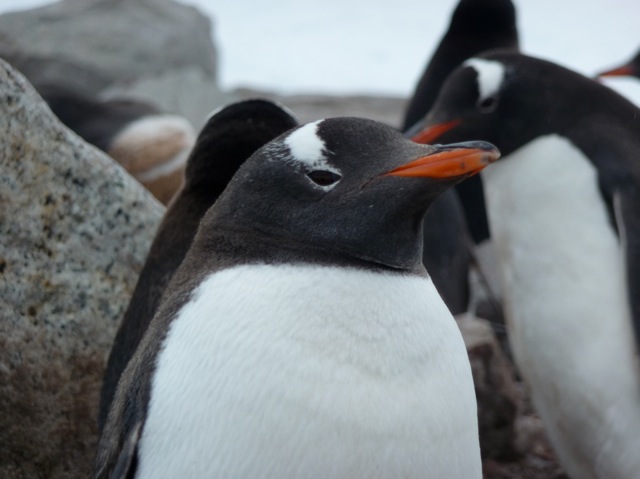
I'm still a little jet lagged so I'm not going to try to catch up right now, but for the time being here's a picture of a Gentoo penguin who posed for me.  We saw gobs of Gentoos, and we were told that they were doing relatively well compared to other penguin species under climate change because of their more diverse diet.  But Wikipedia says their numbers are declining along with pretty much all the rest of the wildlife down there, so I have no idea what the real story is.  All I know is that they are damn cute.


Friday, December 14, 2012

Ecological shocker of the day

White tigers are not actually an endangered species:

[W]hite tigers are not a subspecies at all but rather the result of a mutant gene that has been artificially selected through massive inbreeding to produce oddball animals for human entertainment.